Learn what every symbol on the card means.Full credits and sources at beakbrain.com/symbols
 ForestDomed nestSmall · 21 g

What the Musician Wren sounds like


ID tip
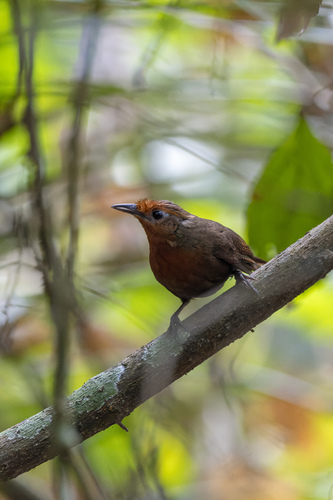
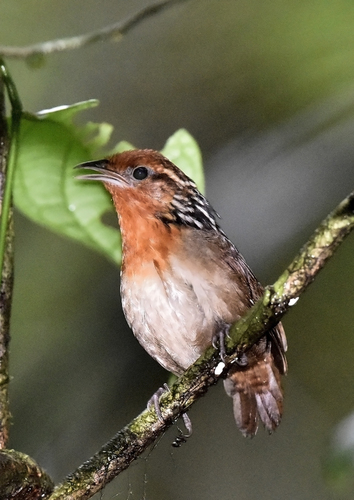
The musician wren is 12.5 cm (4.9 in) long and weighs 18 to 24 g (0.63 to 0.85 oz). The adult of the nominate subspecies has a rufous forehead and forecrown that darkens to chesnut brown to the rear. It has a narrow pale buff supercilium with narrower black borders, a chestnut brown stripe behind the eye, and orange-brown cheeks. It has a broad "collar" streaked black and white lengthwise on its nape and upper back. The lower back and rump are a colder reddish brown than the crown and the tail is medium brown with narrow darker brown bars. Voice: Members of a musician wren pair sing antiphonally, "a series of clear, haunting whistles, varying greatly in pitch". The call is "a harsh 'churk'".
Text from Wikipedia, licensed CC BY-SA 4.0.
When to see the Musician Wren
One bar for each month, and every month is filled: this bird is recorded here in all twelve. The wide bar is July, the month with the most records.
Where to see the Musician Wren
The map shades 9 countries with regular records. Everything unshaded has no records. Countries are listed below the map.
About the Musician Wren
The musician wren or organ wren is a species of wren named for its elaborate song. It is native to the Amazon rainforest in South America, from the lowlands into the foothills of the Andes.
Text adapted from Wikipedia, licensed CC BY-SA 4.0.
Easily confused with
 Southern Chestnut-breasted WrenCyphorhinus thoracicusThe southern chestnut-breasted wren is 11.5 to 15 cm (4.5 to 5.9 in) long and weighs 26.5 to 41 g (0.93 to 1.45 oz).
Northern Chestnut-breasted WrenCyphorhinus dichrousThe northern chestnut-breasted wren is a species of passerine bird in the wren family Troglodytidae that is found in central Colombia, Ecuador and northern Peru.
Southern Chestnut-breasted WrenCyphorhinus thoracicusThe southern chestnut-breasted wren is 11.5 to 15 cm (4.5 to 5.9 in) long and weighs 26.5 to 41 g (0.93 to 1.45 oz).
Northern Chestnut-breasted WrenCyphorhinus dichrousThe northern chestnut-breasted wren is a species of passerine bird in the wren family Troglodytidae that is found in central Colombia, Ecuador and northern Peru.
 Song WrenCyphorhinus phaeocephalusThe song wren is 11.5 to 12.5 cm (4.5 to 4.9 in) long and weighs 25 to 26 g (0.88 to 0.92 oz).
Side by side: Musician Wren vs Song Wren
Learn the Musician Wren in the BeakBrain App
Photo and call practice. Coming soon to iPhone and Android.
Play today's Daily BirdEvery photo and recording on this page is credited to its author under the licence shown. Spotted a problem with this page, or have a better photo? Contribute.