Learn what every symbol on the card means.Full credits and sources at beakbrain.com/symbols
 ForestCavity nestTiny · 12 g


ID tip
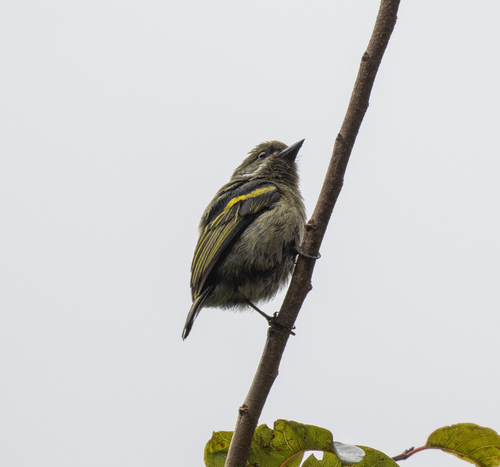
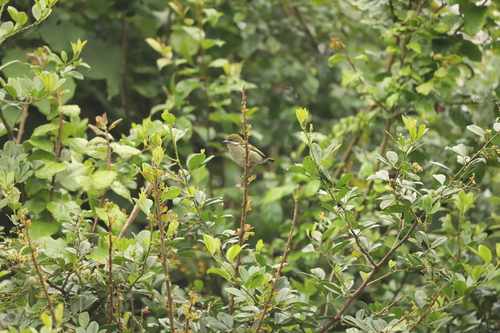
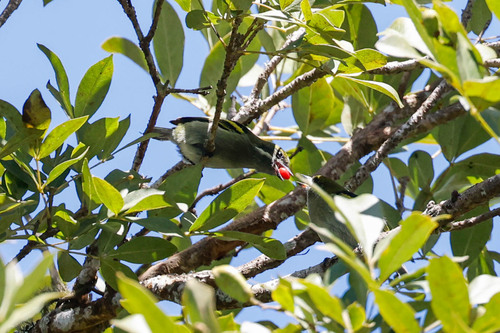
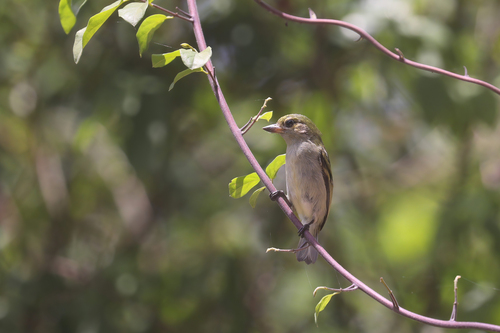
The moustached tinkerbird has mostly a yellow-tinged-green color, a paler belly, and darker undersides. Feathers on the upper lores, ear covert, and the sides of the neck are grey with green tips giving a more olive-grey appearance. From the corners of the bill, the characteristic white slash runs across the lower lores and lines the undereye. From there, it continues down each side of the neck where it broadens and abruptly ends. The blackish sides contrast with the yellow-green back and bright-yellow rump. Yellow-green lines the otherwise black tail feathers. Voice: Both sexes become very vocal during the breeding season. The moustached tinkerbird usually sings when concealed by dense vegetation. Occasionally, they will vocalize out in the open atop a perch. The moustached tinkerbird has two common call patterns. The moustached tinkerbird may discharge a singular trill that is often slower at onset: "pi-pi-pi-pi-i-i-i-i-i-i-i-i-i-i-i".
Text from Wikipedia, licensed CC BY-SA 4.0.
When to see the Moustached Tinkerbird
One bar for each month, and every month is filled: this bird is recorded here in all twelve. The wide bar is October, the month with the most records.
Where to see the Moustached Tinkerbird
The map shades 5 countries with regular records. Everything unshaded has no records. Countries are listed below the map.
About the Moustached Tinkerbird
The moustached tinkerbird is a species of bird in the large Piciformes order in the Lybiidae family. It occurs in high-altitude forests in central Africa. It is greenish with little sexual dimorphism. The tinkerbird eats berries and insects.
Text adapted from Wikipedia, licensed CC BY-SA 4.0.
Easily confused with
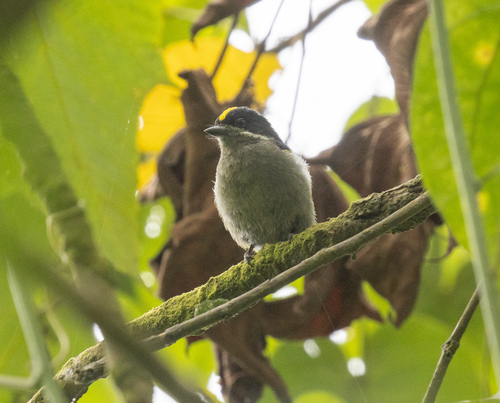 Western TinkerbirdPogoniulus coryphaeaThe western tinkerbird is a species of bird in the family Lybiidae native to Central Africa, where it has been recorded at altitudes from 900 to 3,030 m.
 Green TinkerbirdPogoniulus simplexThe Green Tinkerbird is a diminutive (approximately 11.5 cm, 8.8 g) and active olive-green barbet characterized by a lack of obvious facial markings, a short, two-toned bill with a black tip and yellow base, a conspicuous bright yellow rump, and two distinct yellow wing bars.
 Northern Red-fronted TinkerbirdPogoniulus uropygialisIt is a strikingly marked bird, characterized by a red patch above the bill in adult males.
Learn the Moustached Tinkerbird in the BeakBrain App
Photo and call practice. Coming soon to iPhone and Android.
Play today's Daily BirdEvery photo and recording on this page is credited to its author under the licence shown. Spotted a problem with this page, or have a better photo? Contribute.