Learn what every symbol on the card means.Full credits and sources at beakbrain.com/symbols
 ForestPlatform nestLarge · 486 g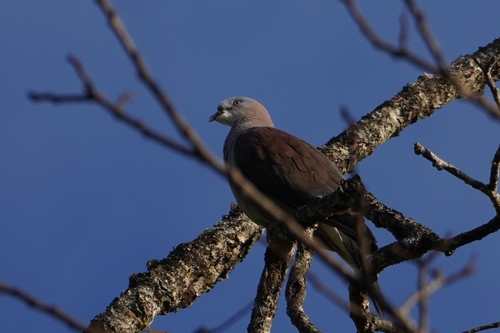
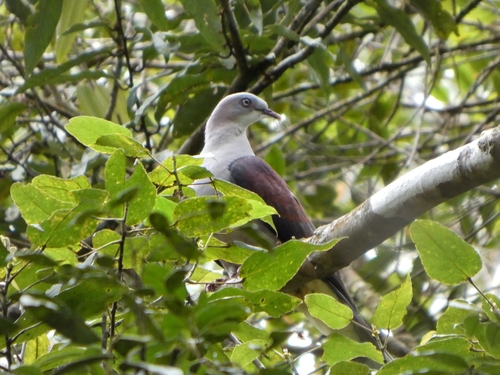
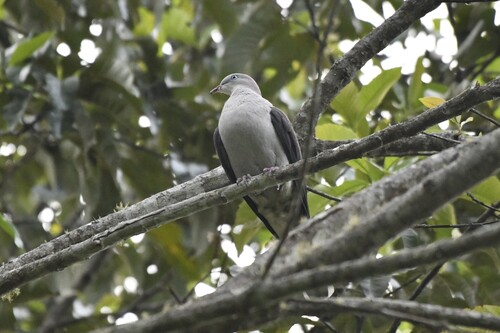
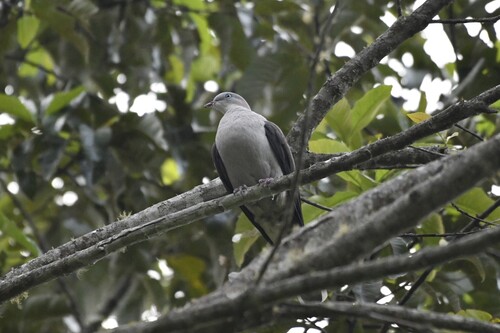
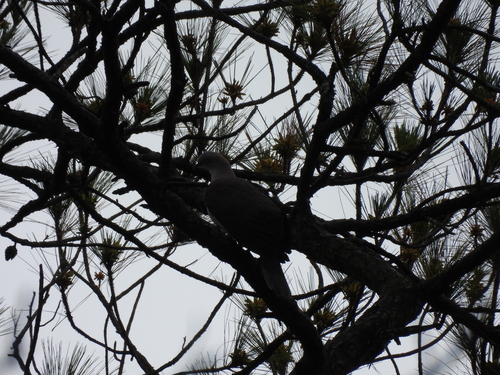
ID tip
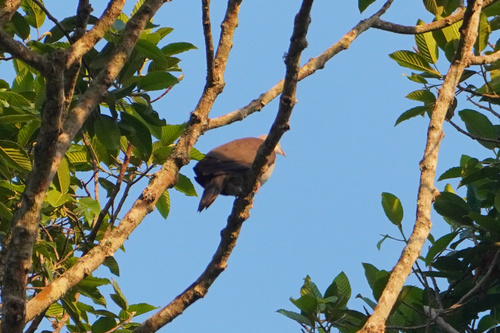
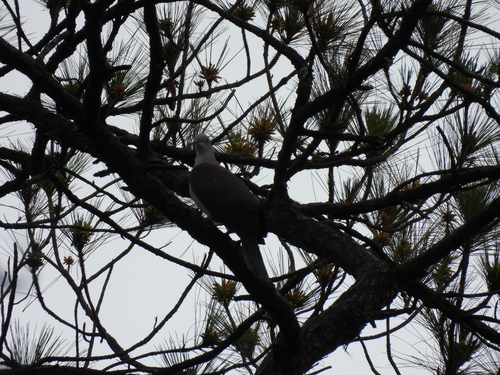
The mountain imperial pigeon is the largest pigeon species in its range at 43–51 cm (17–20 in) long. It has a fairly long tail, broad, rounded wings and slow wing-beats. The head, neck and underparts are vinous-grey with a contrasting white throat and brownish-maroon upperparts and wings, though the upper part of the body can be duller. The underwing is slate-grey and the tail is blackish with a grey horizontal line. The combination the maroon back with the large size give this species a distinctive appearance. Its call consists of a deep, resonant boom that is only detectable at close range.
Text from Wikipedia, licensed CC BY-SA 4.0.
When to see the Mountain Imperial Pigeon
One bar for each month. Filled bars are the 10 months with records; pale bars are months with none. The wide bar is February, the month with the most records.
Where to see the Mountain Imperial Pigeon
The map shades 13 countries with regular records. Everything unshaded has no records. Countries are listed below the map.
About the Mountain Imperial Pigeon
The mountain imperial pigeon, also known as the maroon-backed imperial pigeon or Hodgson's imperial pigeon, is a species of bird in the pigeon and dove family with a wide range in southeastern Asia.
Text adapted from Wikipedia, licensed CC BY-SA 4.0.
Easily confused with
 Torresian Imperial PigeonDucula spilorrhoaThe Torresian imperial pigeon is a large plump pigeon, 38–44 centimetres (15–17.5 inches) in length, and with a 45 cm (18 in) wingspan.
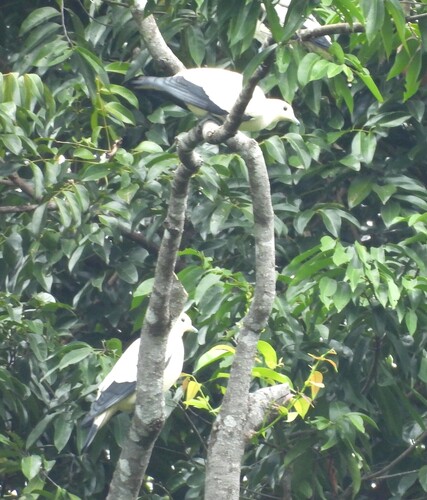 Pied Imperial PigeonDucula bicolorThe pied imperial pigeon is a relatively large, pied species of pigeon.
 Green Imperial PigeonDucula aeneaThe green imperial pigeon is a large, plump pigeon, 45 centimetres (18 in) in length.
Side by side: Green Imperial Pigeon vs Mountain Imperial Pigeon · Mountain Imperial Pigeon vs Torresian Imperial Pigeon
Learn the Mountain Imperial Pigeon in the BeakBrain App
Photo and call practice. Coming soon to iPhone and Android.
Play today's Daily BirdEvery photo and recording on this page is credited to its author under the licence shown. Spotted a problem with this page, or have a better photo? Contribute.