Learn what every symbol on the card means.Full credits and sources at beakbrain.com/symbols
 ForestSmall · 35 g
ID tip
It can be identified by its black mask, white throat, grey breast, grey belly, yellow vent, olive-green back, grey feet, black bill, and white supercilium. Some have a black or dark maroon collar. It is generally perceived as difficult to spot.
Text from Wikipedia, licensed CC BY-SA 4.0.
When to see the Mount Kupe Bushshrike
One bar for each month. Filled bars are the 7 months with records; pale bars are months with none. The wide bar is March, the month with the most records.
Where to see the Mount Kupe Bushshrike
The map shades 2 countries with regular records. Everything unshaded has no records. Countries are listed below the map.
About the Mount Kupe Bushshrike
The Mount Kupe bushshrike is a species of bird in the family Malaconotidae. It was previously thought to be endemic to Cameroon, where it is found in the Bakossi Forest Reserve and in particular on Mount Kupe, where it has been known to attract ecotourists. In 2011 it was reported to be present in two sites in south east Nigeria.
Text adapted from Wikipedia, licensed CC BY-SA 4.0.
Easily confused with
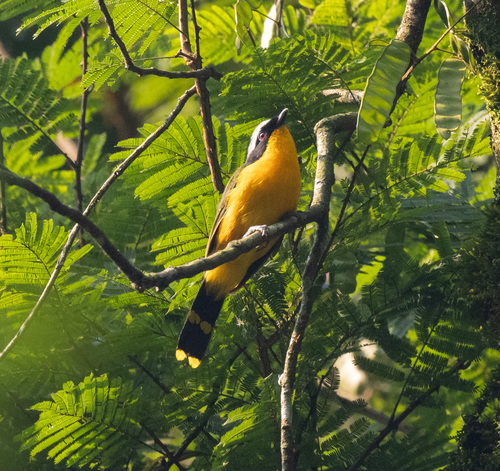 Many-colored BushshrikeChlorophoneus multicolorThe many-colored bushshrike or many-coloured bushshrike is a species of bird in the bushshrike family, Malaconotidae.
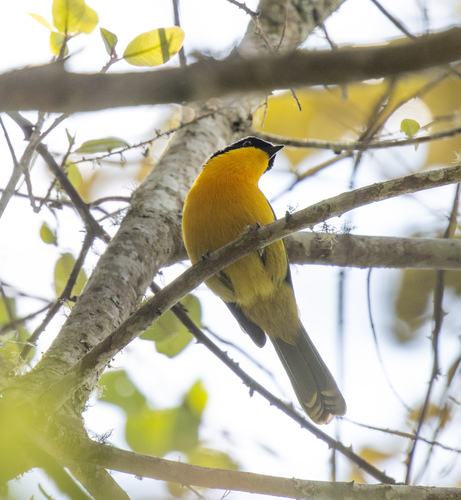 Black-fronted BushshrikeChlorophoneus nigrifronsThe bird is 18–19 centimetres long.
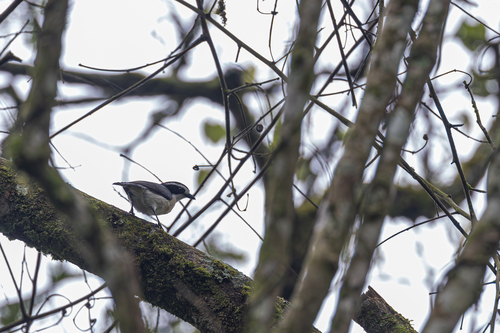 Bocage's BushshrikeChlorophoneus bocageiBocage's bushshrike, also known as the grey-green bushshrike, is a species of bird in the family Malaconotidae.
Learn the Mount Kupe Bushshrike in the BeakBrain App
Photo and call practice. Coming soon to iPhone and Android.
Play today's Daily BirdEvery photo and recording on this page is credited to its author under the licence shown. Spotted a problem with this page, or have a better photo? Contribute.