Learn what every symbol on the card means.Full credits and sources at beakbrain.com/symbols
 GrasslandCavity nestSmall · 45 g


ID tip
The mosque swallow is the largest and heaviest species of African swallow, resembling a big red-rumped swallow Cecropis daurica. The crown, upperparts, and tail are glossy dark blue, and the lores and sides of the head are whitish forming a collar. The rump is dark rufous, while the throat and upper breast are pale rufous, shading to dark rufous on the remainder of the underparts. Very pale underwing coverts contrast with the dark flight feathers. Females are similar to males but have shorter tail streamers. Juveniles are browner. Mosque swallows are 21–23 cm (8.3–9.1 in) in length.
Text from Wikipedia, licensed CC BY-SA 4.0.
When to see the Mosque Swallow
One bar for each month, and every month is filled: this bird is recorded here in all twelve. The wide bar is November, the month with the most records.
Where to see the Mosque Swallow
The map shades 30 countries with regular records, and 4 more in a lighter tone where the bird turns up only as a stray. Everything unshaded has no records. Countries are listed below the map.
Recorded as a rare visitor in Eswatini, South Sudan, Burundi, Niger.
About the Mosque Swallow
The mosque swallow is a large species of swallow. It is a resident breeder in much of sub-Saharan Africa, although most common in the west. It does not migrate but follows the rains to some extent.
Text adapted from Wikipedia, licensed CC BY-SA 4.0.
Easily confused with
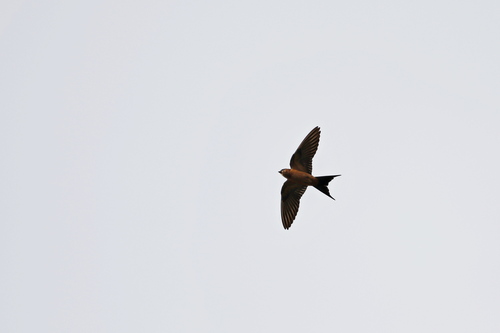 Sri Lanka SwallowCecropis hyperythraIt is a large swallow with a tail which forks deeply, and the combination of deep rufous underside and navy blue rump without any marks is a unique feature of this species.
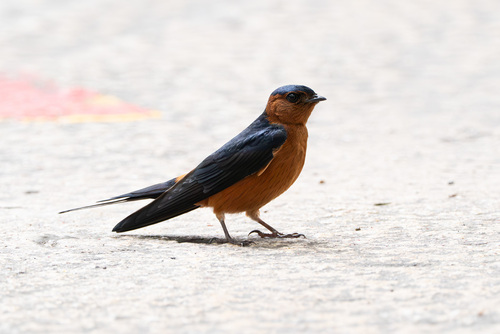 Rufous-bellied SwallowCecropis badiaThe rufous-bellied swallow is a species of swallow that breeds on the Malay Peninsula.
 African Red-rumped SwallowCecropis melanocrissusThe African red-rumped swallow is small passerine bird in the swallow family Hirundinidae.
Side by side: Greater Striped Swallow vs Mosque Swallow · Lesser Striped Swallow vs Mosque Swallow · Mosque Swallow vs Red-breasted Swallow · Mosque Swallow vs Sri Lanka Swallow
Learn the Mosque Swallow in the BeakBrain App
Photo and call practice. Coming soon to iPhone and Android.
Play today's Daily BirdEvery photo and recording on this page is credited to its author under the licence shown. Spotted a problem with this page, or have a better photo? Contribute.