Learn what every symbol on the card means.Full credits and sources at beakbrain.com/symbols
 ForestPlatform nestMedium · 196 g
ID tip
This ground pigeon has been recorded to be around 26 to 30 cm (10 to 12 in) tall. It has a dark grey forehead which transitions into an iridescent green on its head, nape, and hindneck. Its underside–from its throat to its flanks–is a cream-white except for the distinctive patch on the center of its breast which resembles a bright bleeding wound. The chest marking is less prominent and more orange in hue than that of related bleeding-heart doves. The dove's backside contains a reddish purple on its mantle, as well as chestnut coloration on its wings and rump. Voice: Few recordings of the Mindoro bleeding-heart's song exist, and some of those that do are not made publicly available because they threaten to exacerbate issues of trapping and endangerment. However, its call is believed to resemble a "croo croo" not unlike that of the Negros bleeding-heart.
Text from Wikipedia, licensed CC BY-SA 4.0.
When to see the Mindoro Bleeding-heart
One bar for each month. Filled bars are the 3 months with records; pale bars are months with none. The wide bar is December, the month with the most records.
Where to see the Mindoro Bleeding-heart
The map shades 1 country with regular records. Everything unshaded has no records. Countries are listed below the map.
About the Mindoro Bleeding-heart
The Mindoro bleeding-heart, also referred to as kulo-kulo, la-do, manatad, manuk-manuk, punay, and puñalada by the Mangyan, is a species of ground dove native solely to the island of Mindoro in the Philippines. It is critically endangered and threatened by habitat loss through quarrying, land conversion and illegal logging. This species is also caught by hunters in snares. Due to its biological line and its survival status, it has been listed as an EDGE species by the Zoological Society of London. With a lack of any official records after 2005, this species is now one of the rarest birds in the world.
Text adapted from Wikipedia, licensed CC BY-SA 4.0.
Easily confused with
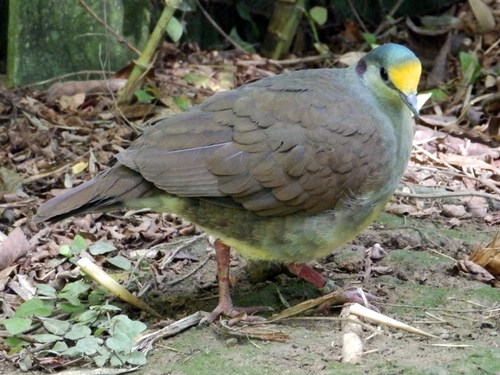 Sulawesi Ground DoveGallicolumba tristigmataThe Sulawesi ground dove, also known as the yellow-breasted ground dove, is a medium-sized, ground-dwelling dove.
 Mindanao Bleeding-heartGallicolumba crinigeraThe Mindanao bleeding-heart, also known as Bartlett's bleeding heart dove, Barlett's bleeding heart pigeon and the hair-breasted bleeding heart, is a species of bird in the pigeon family.
Learn the Mindoro Bleeding-heart in the BeakBrain App
Photo and call practice. Coming soon to iPhone and Android.
Play today's Daily BirdEvery photo and recording on this page is credited to its author under the licence shown. Spotted a problem with this page, or have a better photo? Contribute.