Learn what every symbol on the card means.Full credits and sources at beakbrain.com/symbols
 ForestMedium · 61 g


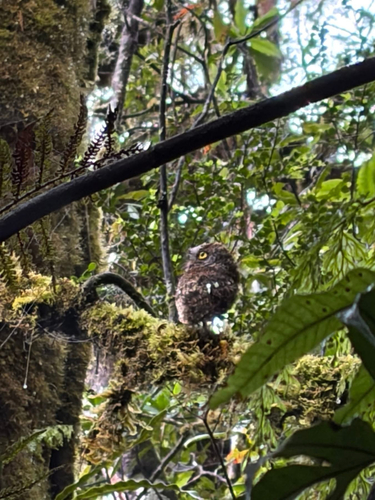
ID tip
Otus mirus is a small owl, with a mean length of 19 cm and body mass of approximately 65 g. It is characterized by heavily barred wings and back, a mottled white and brown front, and small white ear tufts. It shares parts of its range with Everett's scops owl, but is much smaller than this congener.
Text from Wikipedia, licensed CC BY-SA 4.0.
When to see the Mindanao Scops Owl
One bar for each month. Filled bars are the 9 months with records; pale bars are months with none. The wide bar is March, the month with the most records.
Where to see the Mindanao Scops Owl
The map shades 1 country with regular records. Everything unshaded has no records. Countries are listed below the map.
About the Mindanao Scops Owl
The Mindanao scops owl or Mindanao highland scops owl is an owl endemic to Mindanao island in the Philippines. It is found in tropical montane forest above 1,000 meters above sea level. It is threatened by habitat destruction and deforestation.
Text adapted from Wikipedia, licensed CC BY-SA 4.0.
Easily confused with
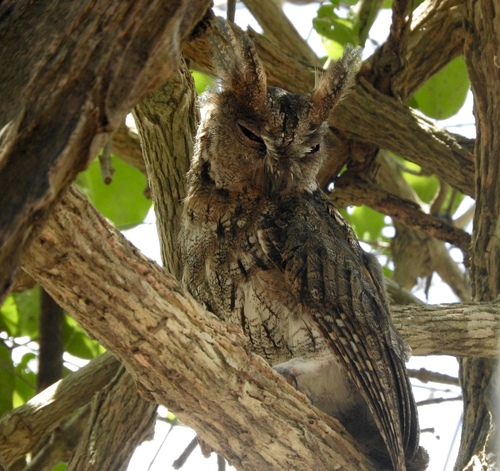 Wallace's Scops OwlOtus silvicolaThe adult Wallace's scops owl has a body length of 23 to 27 cm (9 to 101/2 in), a wingspan between 202 and 251 cm (791/2 and 99 in), and can weigh around 210 g (71/2 oz).
 Palau Scops OwlOtus podarginusThe Palau scops owl or Palau owl is a species of owl in the family Strigidae.
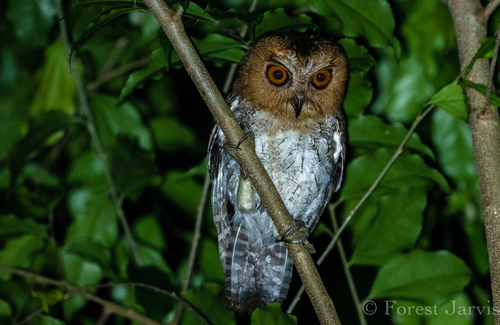 Negros Scops OwlOtus nigrorumThe Negros scops owl, also known as the Visayan scops owl, is an owl, endemic to the islands of Negros and Panay in the Philippines, belonging to the family of the typical owls Strigidae.
Learn the Mindanao Scops Owl in the BeakBrain App
Photo and call practice. Coming soon to iPhone and Android.
Play today's Daily BirdEvery photo and recording on this page is credited to its author under the licence shown. Spotted a problem with this page, or have a better photo? Contribute.