Learn what every symbol on the card means.Full credits and sources at beakbrain.com/symbols
 ForestCavity nestSmall · 35 g


ID tip
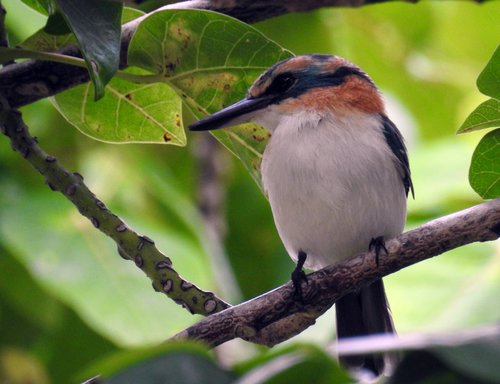
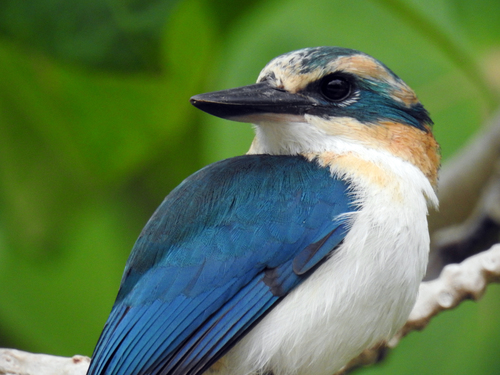
The mewing kingfisher is 22 cm (8.7 in) in length, with blue-green forehead and crown; light turquoise ear-coverts; orange-buff superciliary buff, nape, and upper mantle; deep turquoise back, rump, and uppertail-coverts; deep blue tail (underside blackish); entirely white underparts (except for orange-buff across upper chest); mostly black bill and iris; mostly black legs with light yellow soles. The orange-buff suffusion across the upper chest is more pronounced in females.
Text from Wikipedia, licensed CC BY-SA 4.0.
When to see the Mewing Kingfisher
One bar for each month. Filled bars are the 11 months with records; pale bars are months with none. The wide bar is October, the month with the most records.
Where to see the Mewing Kingfisher
The map shades 1 country with regular records. Everything unshaded has no records. Countries are listed below the map.
About the Mewing Kingfisher
The mewing kingfisher or Mangaia kingfisher, known locally as the tanga'eo, is a species of bird in the Alcedinidae, or kingfisher family. It is endemic to Mangaia in the Cook Islands. Its natural habitats are subtropical or tropical moist lowland forests and plantations.
Text adapted from Wikipedia, licensed CC BY-SA 4.0.
Easily confused with
 Tuamotu KingfisherTodiramphus gambieriThe Mangareva kingfisher has a cream-coloured head and neck, with blue ear-coverts, a white chin and frequently a rufous band across the breast.
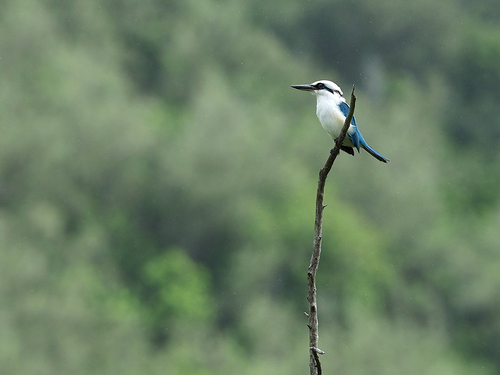 Marquesan KingfisherTodiramphus godeffroyiThis unique bird is approximately 22 cm (9 in) tall with a buff triangle on its upper back.
Islet KingfisherTodiramphus colonusThe islet kingfisher is a species of bird in the family Alcedinidae.
Marquesan KingfisherTodiramphus godeffroyiThis unique bird is approximately 22 cm (9 in) tall with a buff triangle on its upper back.
Islet KingfisherTodiramphus colonusThe islet kingfisher is a species of bird in the family Alcedinidae.
Learn the Mewing Kingfisher in the BeakBrain App
Photo and call practice. Coming soon to iPhone and Android.
Play today's Daily BirdEvery photo and recording on this page is credited to its author under the licence shown. Spotted a problem with this page, or have a better photo? Contribute.