Learn what every symbol on the card means.Full credits and sources at beakbrain.com/symbols
 GrasslandCavity nestSmall · 55 g


ID tip
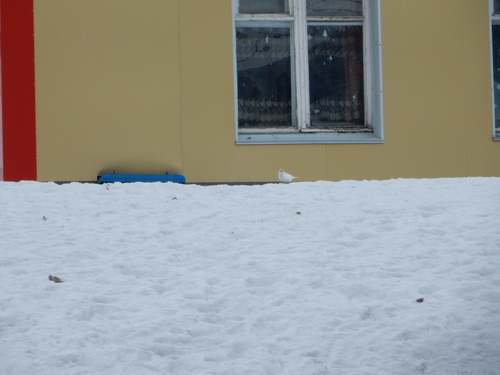
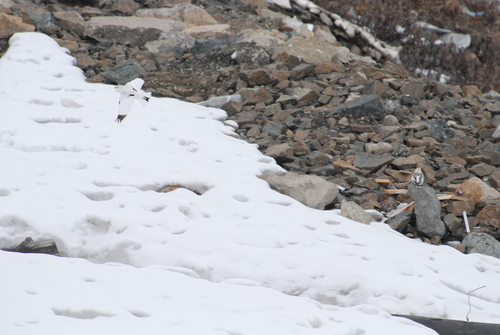
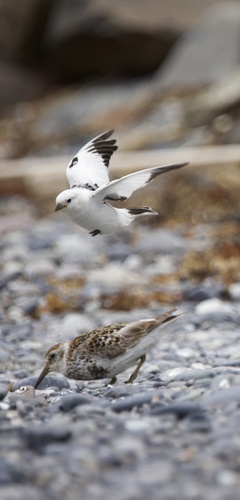
This species closely resembles snow bunting in all plumages, but is whiter overall. The breeding plumage of the male is almost purely white, with only small areas of black on the wingtips and tail. The breeding female has a streaked back. Non-breeding birds also have warm brown patches on cheeks, crown, and the sides of the neck. McKay's bunting is larger on average than the snow bunting. It is 18 cm (7.1 in) long and weighs from 38 to 62 g (1.3 to 2.2 oz), with an average of 54.5 g (1.92 oz). Among standard measurements, the wing chord is 10.1 to 12.2 cm (4.0 to 4.8 in), the tail is 6.4 to 7.
Text from Wikipedia, licensed CC BY-SA 4.0.
When to see the McKay's Bunting
One bar for each month. Filled bars are the 9 months with records; pale bars are months with none. The wide bar is May, the month with the most records.
About the McKay's Bunting
McKay's bunting is a passerine bird in the longspur family Calcariidae. It is most closely related to the snow bunting. Hybrids between the two species have been observed, leading some authorities to treat McKay's as a subspecies of the snow bunting. As the Plectrophenax buntings are nested within the Calcarius clade, their closest relatives are the longspurs. McKay's bunting breeds on two islands in the Bering Sea, St. Matthew and Hall islands, and winters on the western coast of the U.S. state of Alaska.
Text adapted from Wikipedia, licensed CC BY-SA 4.0.
Easily confused with
Learn the McKay's Bunting in the BeakBrain App
Photo and call practice. Coming soon to iPhone and Android.
Play today's Daily BirdEvery photo and recording on this page is credited to its author under the licence shown. Spotted a problem with this page, or have a better photo? Contribute.