Learn what every symbol on the card means.Full credits and sources at beakbrain.com/symbols
 ForestCavity nestMedium · 79 g


What the Masked Tityra sounds like

ID tip
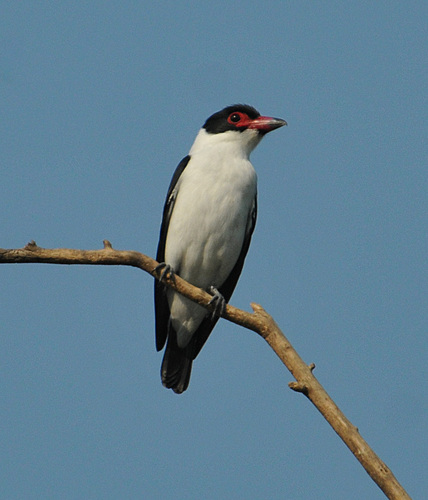
The masked tityra is 20 to 24 cm (7.9 to 9.4 in) long and weighs 77 to 88 g (2.7 to 3.1 oz). The species is sexually dimorphic. Adult males of the nominate subspecies T. s. semifasciata have bare rosy red skin from their bill to and around their eye. They have a black forecrown and the color wraps behind and under the red skin. The rest of their head and their upperparts are pale grayish white with a heavy pearly gray cast. Their wings are mostly black with grayish white tertials. Their tail is grayish white with a wide black band near the end. Their throat and underparts are whitish. Voice: The masked tityra has a wide variety of calls including "a distinctive buzzy, nasal, staccato, and croaking or clicking zzzu rrk or zzr zzzrt and rr-rr-rrk...a dry, nasal, and grunting or almost pig-like querp or kuert, sometimes doubled...or a longer and more rhythmic series of similar notes with two pitches, ghe-rák-gherik".
Text from Wikipedia, licensed CC BY-SA 4.0.
When to see the Masked Tityra
One bar for each month, and every month is filled: this bird is recorded here in all twelve. The wide bar is March, the month with the most records.
Where to see the Masked Tityra
The map shades 16 countries with regular records, and 2 more in a lighter tone where the bird turns up only as a stray. Everything unshaded has no records. Countries are listed below the map.
Recorded as a rare visitor in United States, French Guiana.
About the Masked Tityra
The masked tityra is a medium-sized passerine bird. It is found in Mexico, every Central American country, and every northern and central mainland South American country except the Guianas.
Text adapted from Wikipedia, licensed CC BY-SA 4.0.
Easily confused with
 Black-crowned TityraTityra inquisitorThe black-capped tityra is 16.5 to 20.5 cm (6.5 to 8.1 in) long and weighs 33.8 to 70 g (1.2 to 2.5 oz).
 Black-tailed TityraTityra cayanaThis is a robust, short-tailed bird with a long, hook-tipped bill; like other tityras, it has a peculiar vestigial ninth primary feather.
White-tailed TityraTityra leucuraWhite-tailed tityra is the smallest of its genus.
Black-tailed TityraTityra cayanaThis is a robust, short-tailed bird with a long, hook-tipped bill; like other tityras, it has a peculiar vestigial ninth primary feather.
White-tailed TityraTityra leucuraWhite-tailed tityra is the smallest of its genus.
Side by side: Black-crowned Tityra vs Masked Tityra · Black-tailed Tityra vs Masked Tityra
Learn the Masked Tityra in the BeakBrain App
Photo and call practice. Coming soon to iPhone and Android.
Play today's Daily BirdEvery photo and recording on this page is credited to its author under the licence shown. Spotted a problem with this page, or have a better photo? Contribute.