Learn what every symbol on the card means.Full credits and sources at beakbrain.com/symbols
 ShrublandCup nestSmall · 50 g
What the Martinique Thrasher sounds like

ID tip
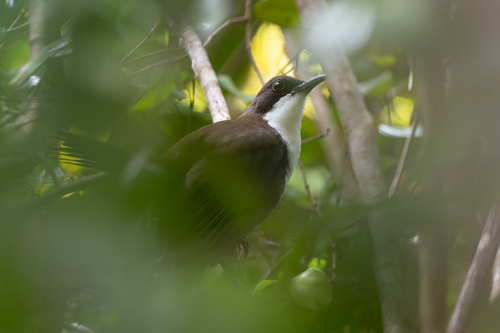
The Martinique thrasher is in average 23 to 25 cm long, and weight from 48 to 60 g depending on sex. An adult bird has a dark brown plumage with a white throat, breast, and belly. Its dark beak is long and slightly decurved towards the tip. Several dark bristles are located around the lores, between the red eyes and nostrils of the bird. This medium-sized passerine has long and strong black legs and can live up to 7–8 years. Males and females are sexually monomorphic, thus identical in size and coloration. This bird is difficult to sex by hand or sight due to sexual monomorphism. Voice: Vocalization repertoire of the Martinique thrasher is limited which is surprising for a species that belongs to Mimids. The Martinique thrashers often vocalize short and harsh calls, and sometimes a musical "tee-rou". Alarm calls are a "grok grok". They are used between birds to warn each other when a threat is perceived. Juveniles are located by thin "tseep" calls.
Text from Wikipedia, licensed CC BY-SA 4.0.
When to see the Martinique Thrasher
One bar for each month. Filled bars are the 9 months with records; pale bars are months with none. The wide bar is February, the month with the most records.
Where to see the Martinique Thrasher
The map shades 1 country with regular records. Everything unshaded has no records. Countries are listed below the map.
About the Martinique Thrasher
The Martinique thrasher is a species of bird in the family Mimidae. Semper and Sclater (1872) describe the white-breasted thrasher as an "inquisitive and noisy bird" that would often "keep up a constant warning chatter, and throw itself about in all sorts of contortions" when being disturbed. It is endemic to Martinique. This resident species is easy to find within its range; however, it is classified as endangered by the IUCN Red List of Threatened Species mainly due to its restricted habitat.
Text adapted from Wikipedia, licensed CC BY-SA 4.0.
Easily confused with
Learn the Martinique Thrasher in the BeakBrain App
Photo and call practice. Coming soon to iPhone and Android.
Play today's Daily BirdEvery photo and recording on this page is credited to its author under the licence shown. Spotted a problem with this page, or have a better photo? Contribute.