Learn what every symbol on the card means.Full credits and sources at beakbrain.com/symbols
 ForestSmall · 45 g
ID tip
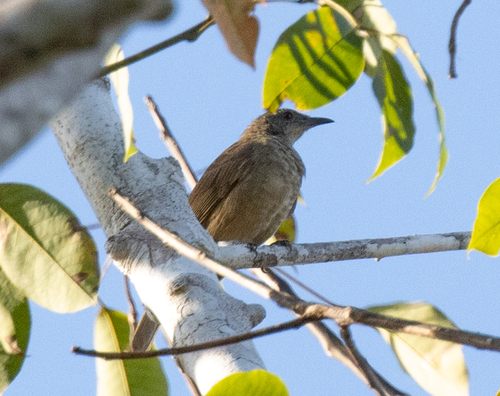
There are two subspecies of the marbled honeyeater, Pycnopygius cinereus dorsalis and Pycnopygius cinereus cinereus. While the two subspecies are similar in appearance, they show slight differences. The marbled honeyeater is described by a variety of colors. The bird's head is dark brown with fine gray streaks on the forehead and bolder streaks on the neck. Around the eyes, the bird has a pale patch and a gray circle. Its upper body is brown with pale gray or olive edges, giving it a streaked look. The wings and tail are brown with olive tones.
Text from Wikipedia, licensed CC BY-SA 4.0.
When to see the Marbled Honeyeater
One bar for each month. Filled bars are the 7 months with records; pale bars are months with none. The wide bar is August, the month with the most records.
Where to see the Marbled Honeyeater
The map shades 2 countries with regular records. Everything unshaded has no records. Countries are listed below the map.
About the Marbled Honeyeater
The marbled honeyeater is a species of bird in the family Meliphagidae. The size of the marbled honeyeater is found to be 20–22 cm. The bird is classified as medium-sized with a medium-length solid bill. The male is 40–58 grams while the female is 36–46 grams in size.
Text adapted from Wikipedia, licensed CC BY-SA 4.0.
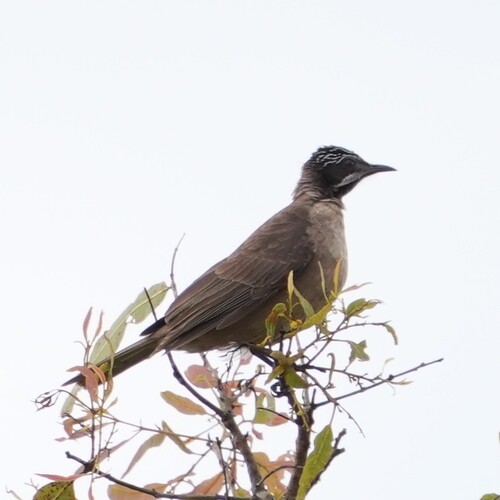
Easily confused with
Learn the Marbled Honeyeater in the BeakBrain App
Photo and call practice. Coming soon to iPhone and Android.
Play today's Daily BirdEvery photo and recording on this page is credited to its author under the licence shown. Spotted a problem with this page, or have a better photo? Contribute.