Learn what every symbol on the card means.Full credits and sources at beakbrain.com/symbols
 WoodlandCup nestSmall · 23 g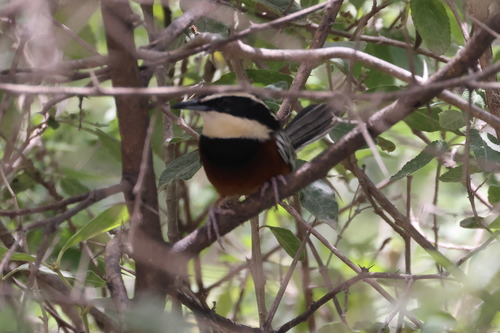
What the Maranon Crescentchest sounds like


ID tip
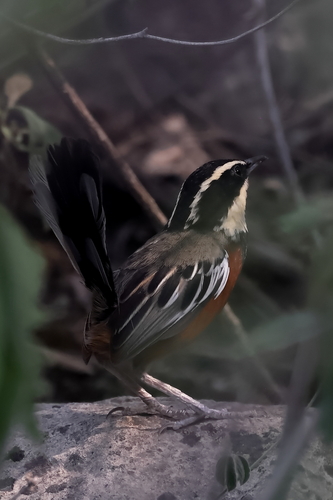
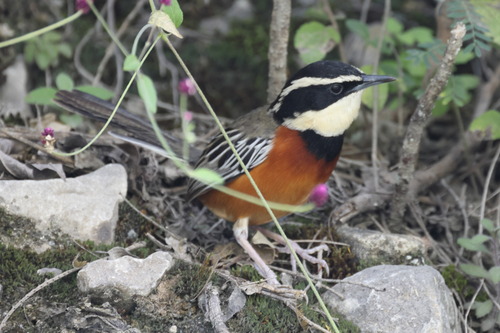
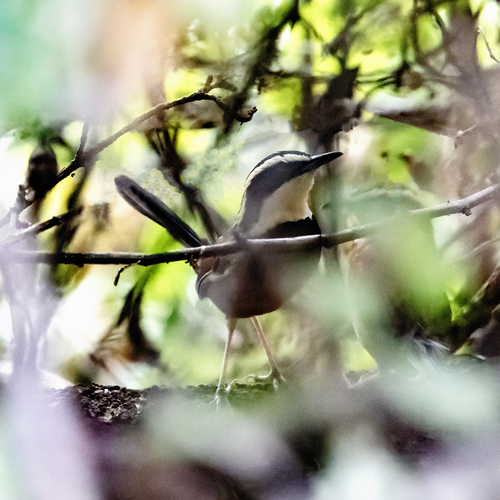
The Marañón crescentchest is 16 cm (6.3 in) long. A female specimen weighed 23 g (0.81 oz). The male's crown and nape are black and its back and rump grayish olive. The chin and throat are white or light buff, and the throat is bordered on its sides and bottom with darker buff. It has broad black band just below the throat that merges into a chestnut breast; below the breast it is tawny. The female has a similar pattern. However, the black band is narrower and the underparts from that band to the tail are an ochraceous tawny.
Text from Wikipedia, licensed CC BY-SA 4.0.
When to see the Maranon Crescentchest
One bar for each month. Filled bars are the 11 months with records; pale bars are months with none. The wide bar is October, the month with the most records.
Where to see the Maranon Crescentchest
The map shades 2 countries with regular records. Everything unshaded has no records. Countries are listed below the map.
About the Maranon Crescentchest
The Marañón crescentchest is a species of bird in the family Melanopareiidae. It is found in southern Ecuador and northern Peru.
Text adapted from Wikipedia, licensed CC BY-SA 4.0.
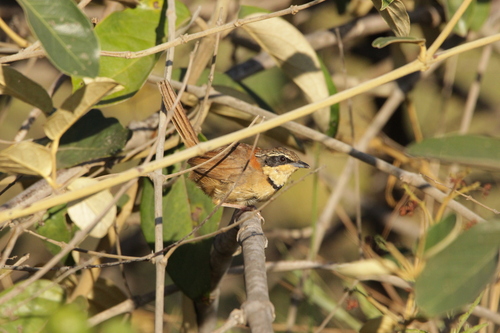
Easily confused with

Learn the Maranon Crescentchest in the BeakBrain App
Photo and call practice. Coming soon to iPhone and Android.
Play today's Daily BirdEvery photo and recording on this page is credited to its author under the licence shown. Spotted a problem with this page, or have a better photo? Contribute.