Learn what every symbol on the card means.Full credits and sources at beakbrain.com/symbols
 ForestCavity nestSmall · 42 g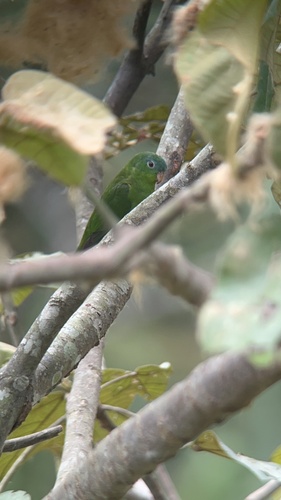
ID tip
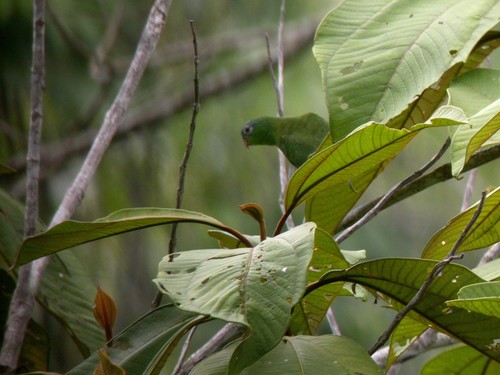
The upper parts, nape, auriculars, dorsum, tertials, wing covers, rump, upper-tail, and rectrices are bright green. The forehead, anterior crown, and ores are a pale blue. The malar area, breast, belly, and under-tail are a paler more yellowish green. No sexual dimorphism has been described as yet.
Text from Wikipedia, licensed CC BY-SA 4.0.
When to see the Manu Parrotlet
One bar for each month. Filled bars are the 8 months with records; pale bars are months with none. The wide bar is July, the month with the most records.
Where to see the Manu Parrotlet
The map shades 3 countries with regular records. Everything unshaded has no records. Countries are listed below the map.
About the Manu Parrotlet
The Manu parrotlet or Amazonian parrotlet is a species of parrotlet native to the western Amazon basin, from southern Peru to northwest Bolivia. It is found in lowland forests near bamboo and rivers.
Text adapted from Wikipedia, licensed CC BY-SA 4.0.
Easily confused with
Learn the Manu Parrotlet in the BeakBrain App
Photo and call practice. Coming soon to iPhone and Android.
Play today's Daily BirdEvery photo and recording on this page is credited to its author under the licence shown. Spotted a problem with this page, or have a better photo? Contribute.