Learn what every symbol on the card means.Full credits and sources at beakbrain.com/symbols
 ForestCavity nestMedium · 292 g


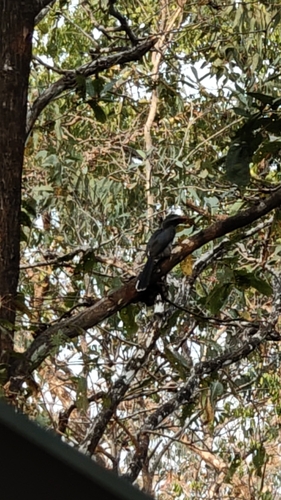
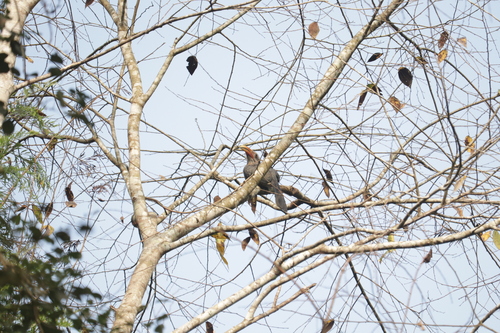
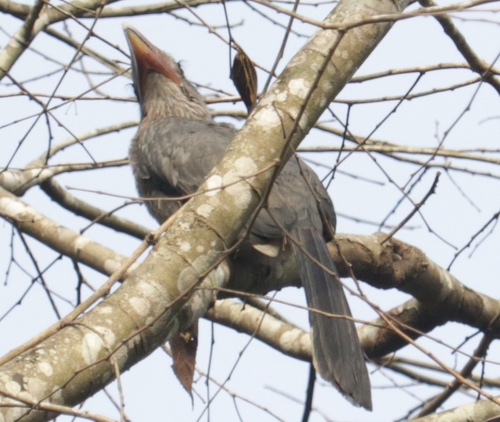
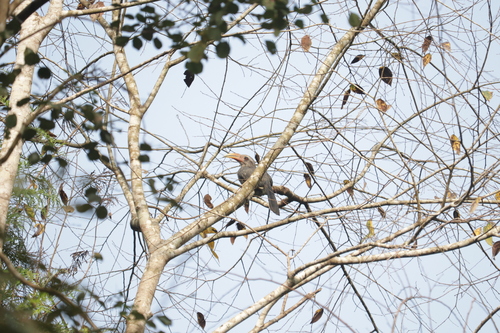
What the Malabar Grey Hornbill sounds like


ID tip
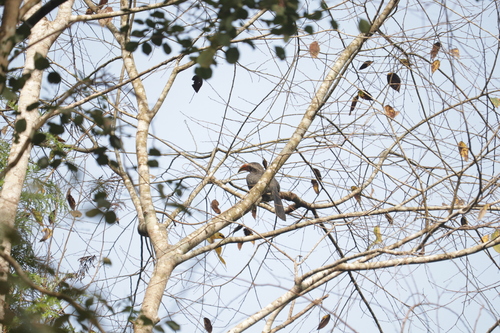
The Malabar grey hornbill is a large bird, but at 45 to 58 cm (18 to 23 in) in length it is still the smallest of the Asian hornbills. It has a 23 cm (9.1 in) tail and pale or yellowish to orange bill. Males have a reddish bill with a yellow tip, while the females have a plain yellow bill with black at the base of the lower mandible and a black stripe along the culmen. They show a broad whitish superciliary band above the eye, running down to the neck. They fly with a strong flap and glide flight and hop around heavily on the outer branches of large fruiting trees.
Text from Wikipedia, licensed CC BY-SA 4.0.
When to see the Malabar Grey Hornbill
One bar for each month. Filled bars are the 10 months with records; pale bars are months with none. The wide bar is February, the month with the most records.
Where to see the Malabar Grey Hornbill
The map shades 1 country with regular records. Everything unshaded has no records. Countries are listed below the map.
About the Malabar Grey Hornbill
The Malabar gray hornbill is a hornbill endemic to the Western Ghats and associated hills of southern India. They have a large beak but lack the casque that is prominent in some other hornbill species. They are found mainly in dense forest and around rubber, arecanut or coffee plantations. They move around in pairs or small groups, feeding on figs and other forest fruits. Their loud cackling and laughing call makes them familiar to people living in the region.
Text adapted from Wikipedia, licensed CC BY-SA 4.0.
Easily confused with
 Sri Lanka Grey HornbillOcyceros gingalensisThe Sri Lanka grey hornbill is a large bird at 45 centimetres (18 in) in length.
 Indian Grey HornbillOcyceros birostrisThe Indian grey hornbill is a medium-sized hornbill, measuring around 61 cm (24 in) in length.
Side by side: Indian Grey Hornbill vs Malabar Grey Hornbill · Malabar Grey Hornbill vs Sri Lanka Grey Hornbill
Learn the Malabar Grey Hornbill in the BeakBrain App
Photo and call practice. Coming soon to iPhone and Android.
Play today's Daily BirdEvery photo and recording on this page is credited to its author under the licence shown. Spotted a problem with this page, or have a better photo? Contribute.