Learn what every symbol on the card means.Full credits and sources at beakbrain.com/symbols


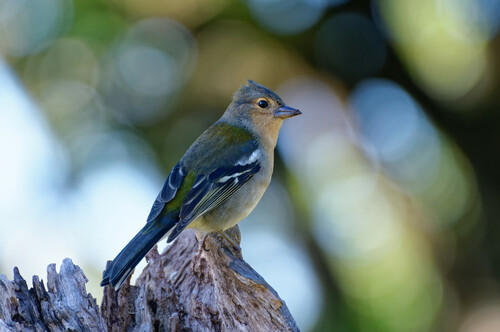
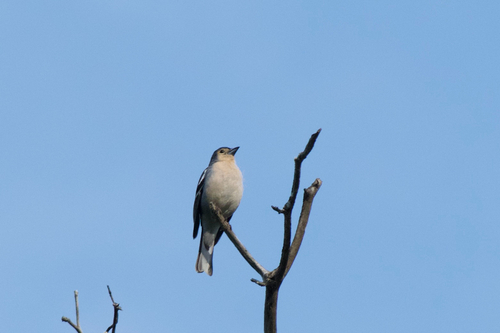
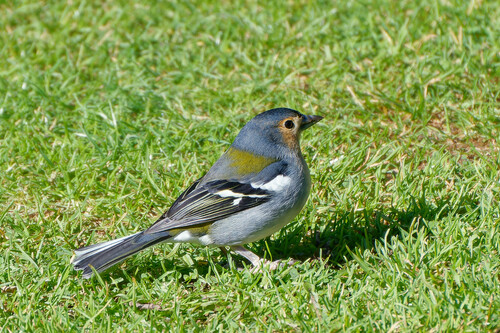
ID tip
The male is more brightly coloured than the female. It has a pinkish breast, bluish-grey cap and greenish-brown back. The female's colouring is more subdued with a cream breast and brownish back, but both sexes have prominent white wing-bars and tail-sides. The length is 14.5–16 cm (5.7–6.3 in).
Text from Wikipedia, licensed CC BY-SA 4.0.
When to see the Madeira Chaffinch
One bar for each month. Filled bars are the 11 months with records; pale bars are months with none. The wide bar is May, the month with the most records.
Where to see the Madeira Chaffinch
The map shades 1 country with regular records. Everything unshaded has no records. Countries are listed below the map.
About the Madeira Chaffinch
The Madeira chaffinch is a small passerine bird in the finch family Fringillidae. It was formerly treated as a subspecies of the Eurasian chaffinch, but was recently revised to be a species in its own right, following a genetic and morphological analysis of the genus Fringilla in 2021. It is endemic to the Portuguese island of Madeira, part of Macaronesia in the North Atlantic Ocean. It is locally known as the tentilhão.
Text adapted from Wikipedia, licensed CC BY-SA 4.0.
Easily confused with
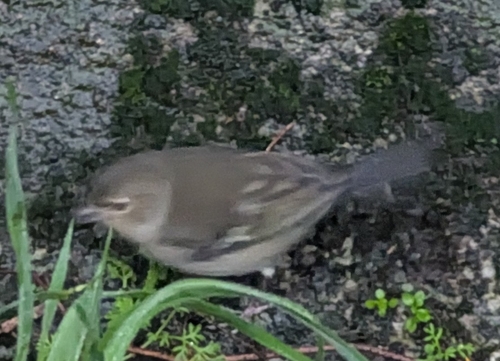 Canary Islands ChaffinchFringilla canariensisThe Canary Islands chaffinch is similar in size to the Eurasian chaffinch at around 15–16 cm long, but differs markedly in plumage of the male, with a dark blue-grey mantle, and lighter pink face and breast, and whiter belly and undertail.
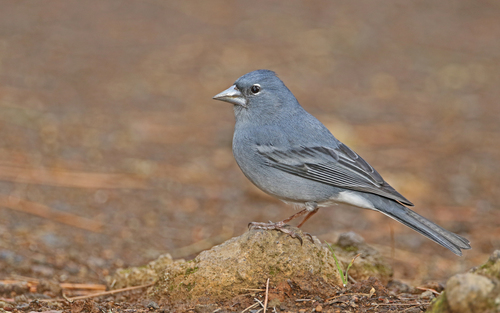 Tenerife Blue ChaffinchFringilla teydeaTenerife blue chaffinches resemble common chaffinches, but they are noticeably larger, and have a thicker bill.
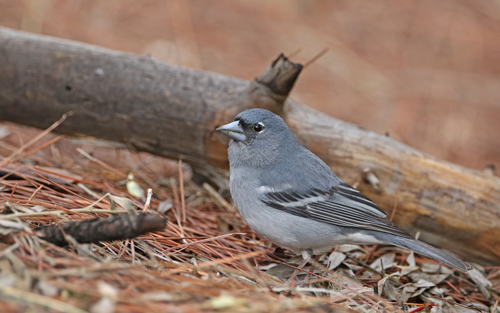 Gran Canaria Blue ChaffinchFringilla polatzekiThe Gran Canaria blue chaffinch is slightly smaller than the Tenerife blue chaffinch; males weigh 27–29 g and females 26–28 g, compared to 31–33 g and 28–30 g respectively for Tenerife blue chaffinch.
Learn the Madeira Chaffinch in the BeakBrain App
Photo and call practice. Coming soon to iPhone and Android.
Play today's Daily BirdEvery photo and recording on this page is credited to its author under the licence shown. Spotted a problem with this page, or have a better photo? Contribute.