Learn what every symbol on the card means.Full credits and sources at beakbrain.com/symbols
 MarineScrapeHuge · 4.5 kg



What the Macaroni Penguin sounds like


ID tip
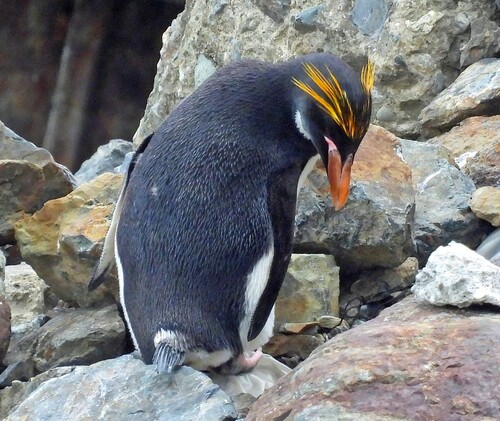
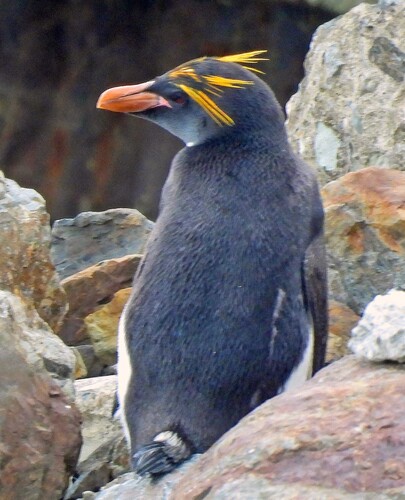
The macaroni penguin is a large, crested penguin, similar in appearance to other members of the genus Eudyptes. An adult bird has an average length of around 70 cm (28 in); the weight varies markedly depending on time of year and sex. Males average from 3.3 kg (7 lb) after incubating, or 3.7 kg (8 lb) after moult to 6.4 kg (14 lb) before moult, while females average 3.2 kg (7 lb) after to 5.7 kg (13 lb) before moult. Among standard measurements, the thick bill (from the gape) measures 7 to 8 cm (2.8 to 3.1 in), the culmen being around a centimetre less.
Text from Wikipedia, licensed CC BY-SA 4.0.
When to see the Macaroni Penguin
One bar for each month. Filled bars are the 7 months with records; pale bars are months with none. The wide bar is January, the month with the most records.
Where to see the Macaroni Penguin
The map shades 4 countries with regular records, and 4 more in a lighter tone where the bird turns up only as a stray. Everything unshaded has no records. Countries are listed below the map.
Recorded as a rare visitor in Australia, United Kingdom, Norway, New Zealand.
About the Macaroni Penguin
The macaroni penguin is a species of penguin found from the Subantarctic to the Antarctic Peninsula. One of eight species of crested penguin, it is very closely related to the royal penguin, and some authorities consider the two to be a single species. It bears a distinctive yellow crest on its forehead. Its face and upperparts are black and sharply delineated from the white underparts. Adults weigh on average 5.5 kg (12 lb) and are 70 cm (28 in) in length. The male and female are similar in appearance; the male is slightly larger and stronger with a larger bill.
Text adapted from Wikipedia, licensed CC BY-SA 4.0.
Easily confused with
 Western Rockhopper PenguinEudyptes chrysocomeThis is the smallest of the yellow-crested, black-and-white penguins in the genus Eudyptes.
 Fiordland PenguinEudyptes pachyrhynchusThis species is a medium-sized, yellow-crested, black-and-white penguin, growing to approximately 55 cm (22 in) long and weighing on average 3.5 kg (7.7 lb), with a weight range of 2 to 5 kg (4.4 to 11.0 lb).
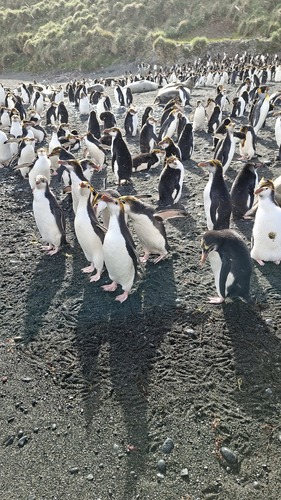 Royal PenguinEudyptes schlegeliThe royal penguin closely resembles the macaroni penguin (Eudyptes chrysolophus), from which it differs primarily in having a white or pale grey face and chin rather than black.
Side by side: Macaroni Penguin vs Western Rockhopper Penguin · Macaroni Penguin vs Yellow-eyed Penguin
Learn the Macaroni Penguin in the BeakBrain App
Photo and call practice. Coming soon to iPhone and Android.
Play today's Daily BirdEvery photo and recording on this page is credited to its author under the licence shown. Spotted a problem with this page, or have a better photo? Contribute.