Learn what every symbol on the card means.Full credits and sources at beakbrain.com/symbols

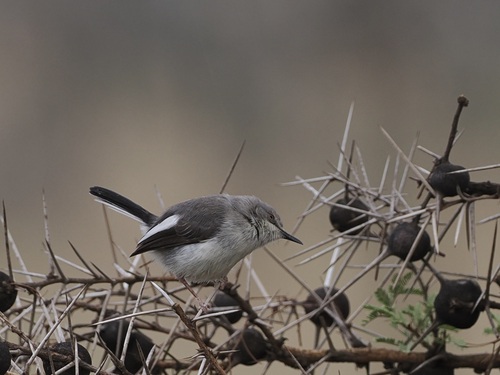
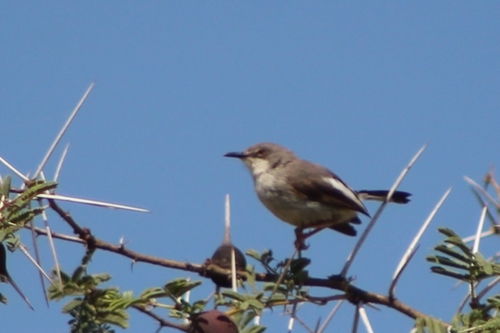
ID tip
The Maasai apalis is a small bird, being slightly larger than the related Karamoja apalis. It differs from the Karamoja apalis by its slaty grey mottled breast and flanks. Females can be told apart from males by their dark underparts. Both sexes have a red or orange iris, a long black bill, grey upperparts, a black and white tail, and pink legs. Both sexes also have white lines on their wing and the rectrices of their tail, thought to mimic the long white spines of the whistling thorn.
Text from Wikipedia, licensed CC BY-SA 4.0.
When to see the Maasai Apalis
One bar for each month, and every month is filled: this bird is recorded here in all twelve. The wide bar is November, the month with the most records.
Where to see the Maasai Apalis
The map shades 36 countries with regular records, and 6 more in a lighter tone where the bird turns up only as a stray. Everything unshaded has no records. Countries are listed below the map.
Recorded as a rare visitor in France, Togo, Burkina Faso, South Sudan, Mali, EH.
About the Maasai Apalis
The Maasai apalis, is a species of passerine in the family Cisticolidae. It is native to Tanzania and southwest Kenya. It was formerly considered a subspecies of Karamoja apalis until being split in 2024 by the IOC and Clements checklist.
Text adapted from Wikipedia, licensed CC BY-SA 4.0.
Easily confused with
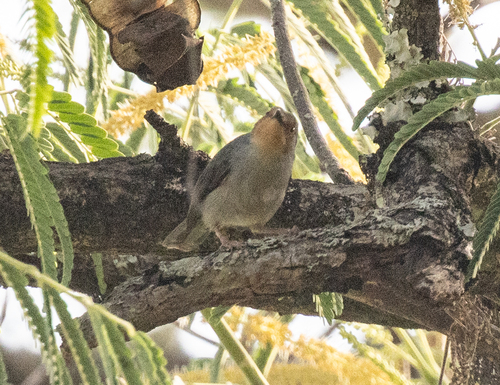 Bamenda ApalisApalis bamendaeThe Bamenda apalis is a species of bird in the family Cisticolidae.
Learn the Maasai Apalis in the BeakBrain App
Photo and call practice. Coming soon to iPhone and Android.
Play today's Daily BirdEvery photo and recording on this page is credited to its author under the licence shown. Spotted a problem with this page, or have a better photo? Contribute.