Learn what every symbol on the card means.Full credits and sources at beakbrain.com/symbols
 ForestCavity nestMedium · 83 g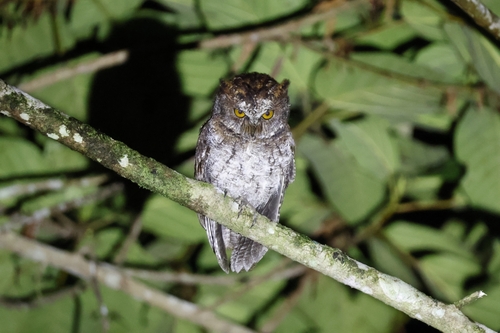
ID tip
The Luzon scops owl is relatively small even among species of scops owls endemic to the Philippines. It has a body length of 18 to 19 cm with a wing length of 13.6 to 15.3 cm. Their large eyes have bright yellow irises, and their beaks are small and slender. Their tarsi are feathered, but only until about halfway through its length and they are equipped with long, sharp claws, typical of birds of prey. Characteristic of scops owls, this species has long ear tufts and an overall dark brown and rufous plumage. Horizontal dark bars irregularly streak across most of its feathers. Voice: Recorded male vocalizations appear to be more frequent at night and consist of a single note that lowers in pitch, each whistle being separated by 3 to 5 seconds of silence. Their vocalization is said to resemble that of the Eurasian scops owl (Otus scops), however the single whistle type of vocalization is characteristic of many other scops owl species.
Text from Wikipedia, licensed CC BY-SA 4.0.
When to see the Luzon Scops Owl
One bar for each month. Filled bars are the 8 months with records; pale bars are months with none. The wide bar is February, the month with the most records.
Where to see the Luzon Scops Owl
The map shades 1 country with regular records. Everything unshaded has no records. Countries are listed below the map.
About the Luzon Scops Owl
The Luzon scops owl or the Luzon highland scops owl is a species of scops owl endemic to Luzon, Philippines. Not to be confused with the Philippine scops owl, sometimes referred to as the Luzon lowland scops owl, which is a more common species that shares the same range. The Luzon scops owl, however, is smaller and inhabits higher altitudes than its lowland relative.
Text adapted from Wikipedia, licensed CC BY-SA 4.0.
Easily confused with
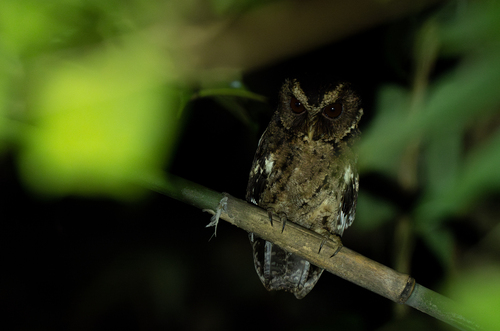 Palawan Scops OwlOtus fuliginosusThe Palawan scops owl is an owl endemic to the Philippines only being found on the island of Palawan.
 Palau Scops OwlOtus podarginusThe Palau scops owl or Palau owl is a species of owl in the family Strigidae.
 Japanese Scops OwlOtus semitorquesJapanese scops-owls are 16.5–30 cm (6.5–11.8 in) tall, and their wingspan is 60–66 cm (23.5–26 in).
Learn the Luzon Scops Owl in the BeakBrain App
Photo and call practice. Coming soon to iPhone and Android.
Play today's Daily BirdEvery photo and recording on this page is credited to its author under the licence shown. Spotted a problem with this page, or have a better photo? Contribute.