Learn what every symbol on the card means.Full credits and sources at beakbrain.com/symbols
 ForestCup nestTiny · 5 g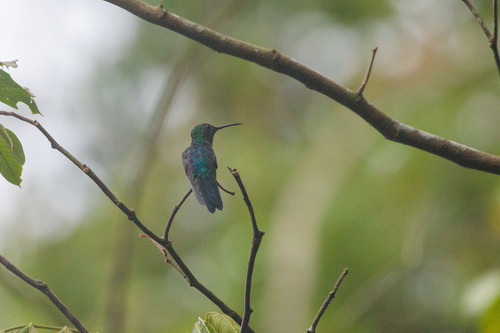
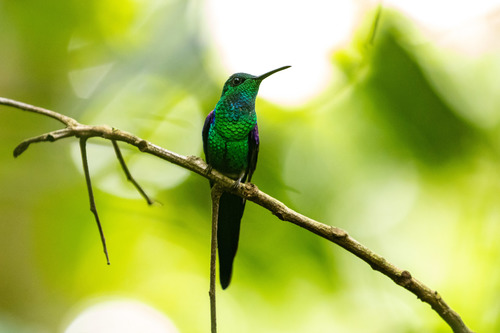
ID tip
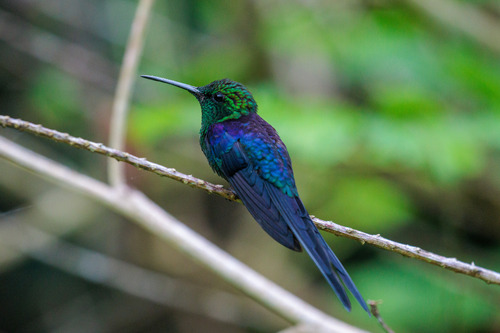
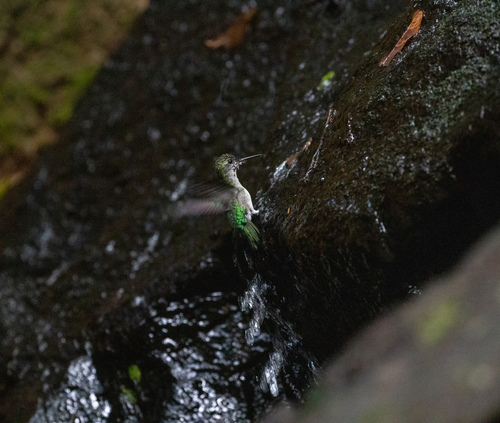
The long-tailed woodnymph is sexually dimorphic. The males are heavier, with significantly larger wings and tails, whereas the females have longer bills. Males are approximately 11.8–13 centimetres (4.6–5.1 in) long, including a tail of 6 centimetres (2.4 in) cm; while females measure roughly 10–11 centimetres (3.9–4.3 in) in length, with a tail of 3.6 centimetres (1.4 in). Individuals have a weight of 3.7–5.2 g. Males have a conspicuous iridescent plumage in blue, green and purple.
Text from Wikipedia, licensed CC BY-SA 4.0.
When to see the Long-tailed Woodnymph
One bar for each month. Filled bars are the 9 months with records; pale bars are months with none. The wide bar is November, the month with the most records.
Where to see the Long-tailed Woodnymph
The map shades 1 country with regular records. Everything unshaded has no records. Countries are listed below the map.
About the Long-tailed Woodnymph
The long-tailed woodnymph is a species of hummingbird in the family Trochilidae. It is found in humid forest in northeastern Brazil, where it is known from the states of Pernambuco, Alagoas, Sergipe and the northernmost Bahia. It is usually thought to be widespread, but seen at low density in its increasingly fragmented range. Its population is estimated to be around 1,000–2,500 individuals, currently in decline due to deforestation and habitat loss.
Text adapted from Wikipedia, licensed CC BY-SA 4.0.
Easily confused with
 Fork-tailed WoodnymphThalurania furcataFork-tailed woodnymph males are 9.5 to 12.9 cm (3.7 to 5.1 in) long and weigh 3.6 to 6 g (0.13 to 0.21 oz).
 Violet-capped WoodnymphThalurania glaucopisThe violet-capped hummingbird is 8 to 11 cm (3.1 to 4.3 in) long.
 Crowned WoodnymphThalurania colombicaMale crowned woodnymphs are 9.5 to 11.5 cm (3.7 to 4.5 in) long and weigh 4 to 5.5 g (0.14 to 0.19 oz).
Learn the Long-tailed Woodnymph in the BeakBrain App
Photo and call practice. Coming soon to iPhone and Android.
Play today's Daily BirdEvery photo and recording on this page is credited to its author under the licence shown. Spotted a problem with this page, or have a better photo? Contribute.