Learn what every symbol on the card means.Full credits and sources at beakbrain.com/symbols
 ForestCup nestTiny · 7 g



ID tip
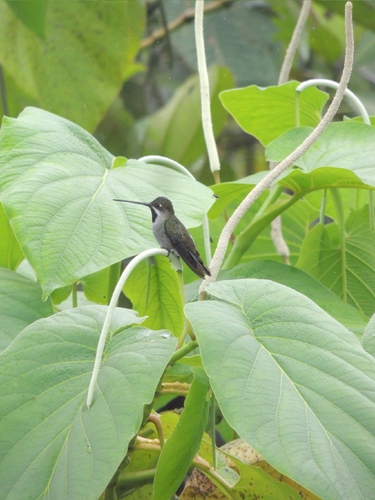
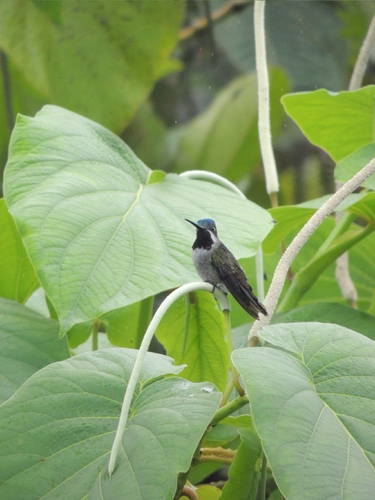
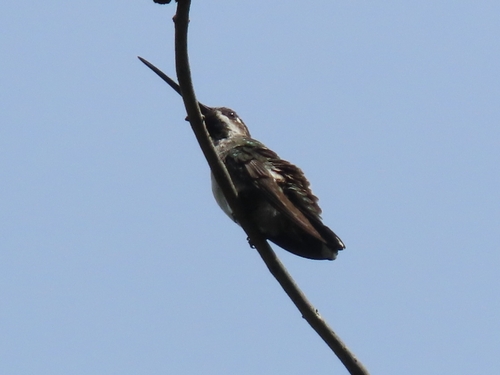
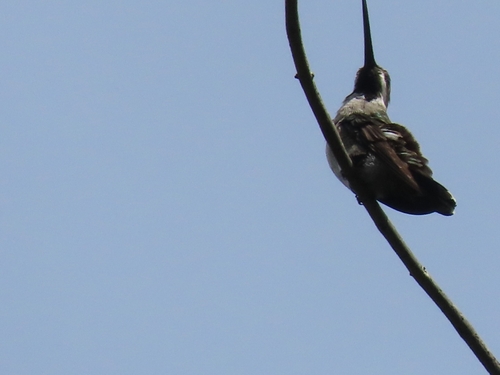
The long-billed starthroat is 11 to 12 cm (4.3 to 4.7 in) long. Males weigh 5.5 to 7.1 g (0.19 to 0.25 oz) and females about 6.5 g (0.23 oz). Both sexes of all subspecies have a long, almost straight, black bill and a small white spot behind the eye. Males of the nominate subspecies have a glittering blue to greenish blue crown; the rest of its upperparts are dark bronzy green with the exception of a white stripe down the center of the rump. The face is black below the crown and has a white malar stripe below the black. Its tail is rather short and square-tipped. Voice: The long-billed starthroat's calls include "a rich liquid 'tseep' or 'tsew'" and "sqeaky twitters"; the latter is made during chases.
Text from Wikipedia, licensed CC BY-SA 4.0.
When to see the Long-billed Starthroat
One bar for each month, and every month is filled: this bird is recorded here in all twelve. The wide bar is October, the month with the most records.
Where to see the Long-billed Starthroat
The map shades 18 countries with regular records, and 1 more in a lighter tone where the bird turns up only as a stray. Everything unshaded has no records. Countries are listed below the map.
Recorded as a rare visitor in Paraguay.
About the Long-billed Starthroat
The long-billed starthroat is a species of hummingbird in the "mountain gems", tribe Lampornithini in subfamily Trochilinae. It is found in Mexico, Central America, Trinidad, and all but the four southernmost countries of South America.
Text adapted from Wikipedia, licensed CC BY-SA 4.0.
Easily confused with
 Plain-capped StarthroatHeliomaster constantiiThe plain-capped starthroat is 11 to 13 cm (4.3 to 5.1 in) long.
 Blue-tufted StarthroatHeliomaster furciferThe blue-tufted starthroat is 12.6 to 13 cm (5.0 to 5.1 in) long and weighs 5 to 6.5 g (0.18 to 0.23 oz).
 Stripe-breasted StarthroatHeliomaster squamosusThe stripe-breasted starthroat is 11.2 to 12.4 cm (4.4 to 4.9 in) long and weighs 5 to 6.5 g (0.18 to 0.23 oz).
Side by side: Long-billed Starthroat vs Plain-capped Starthroat · Blue-tufted Starthroat vs Long-billed Starthroat · Long-billed Starthroat vs Stripe-breasted Starthroat
Learn the Long-billed Starthroat in the BeakBrain App
Photo and call practice. Coming soon to iPhone and Android.
Play today's Daily BirdEvery photo and recording on this page is credited to its author under the licence shown. Spotted a problem with this page, or have a better photo? Contribute.