Learn what every symbol on the card means.Full credits and sources at beakbrain.com/symbols
 MarineCavity nestMedium · 226 g


ID tip
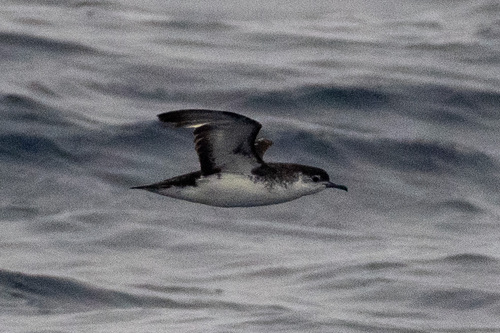
This shearwater has the typically "shearing" flight of the genus, dipping from side to side on stiff wings with few beats, the wingtips almost touching the water, though in light winds it has a more flapping flight than that of its larger relatives. In flight it looks cross-shaped, with its wings held at right angles to the body, its colouration changing from black to white as the black upperparts and white underparts are alternately exposed as it travels low over the sea. At 25–30 cm (9.8–11.
Text from Wikipedia, licensed CC BY-SA 4.0.
When to see the Little Shearwater
One bar for each month. Filled bars are the 10 months with records; pale bars are months with none. The wide bar is November, the month with the most records.
Where to see the Little Shearwater
The map shades 5 countries with regular records, and 6 more in a lighter tone where the bird turns up only as a stray. Everything unshaded has no records. Countries are listed below the map.
Recorded as a rare visitor in South Africa, France, Argentina, Canada, Spain, French Guiana.
About the Little Shearwater
The little shearwater is a small shearwater in the petrel family Procellariidae. Despite the generic name, it is unrelated to the puffins, which are auks, the only similarity being that they are both burrow-nesting seabirds.
Text adapted from Wikipedia, licensed CC BY-SA 4.0.
Easily confused with
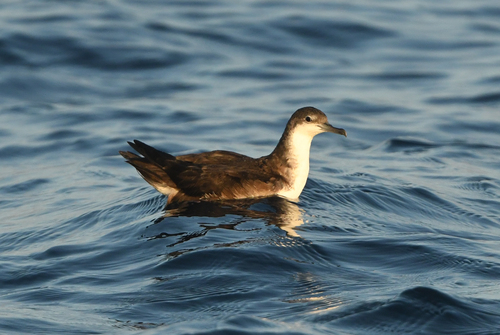 Persian ShearwaterPuffinus persicusThe Persian shearwater is a seabird in the family Procellariidae formerly lumped in with Audubon's shearwater.
 Barolo ShearwaterPuffinus baroliThe Barolo shearwater is visually similar to the Manx shearwater and other North Atlantic Puffinus, but can be distinguished by features such as a pale face with a darkly contrasting eye, a silvery panel in the upperwings, shorter more rounded wings, and blue feet.
 Tropical ShearwaterPuffinus bailloniThe tropical shearwater is a seabird in the family Procellariidae formerly considered conspecific with Audubon's shearwater.
Learn the Little Shearwater in the BeakBrain App
Photo and call practice. Coming soon to iPhone and Android.
Play today's Daily BirdEvery photo and recording on this page is credited to its author under the licence shown. Spotted a problem with this page, or have a better photo? Contribute.