Learn what every symbol on the card means.Full credits and sources at beakbrain.com/symbols
 ShrublandCavity nestSmall · 18 g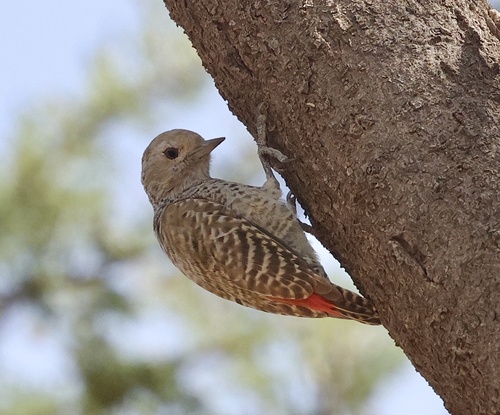

ID tip
The little grey woodpecker is a very small woodpecker, growing to a length of between 12 and 14 cm (4.7 and 5.5 in). The beak is relatively long and broad. The male has a red hind crown and nape while the female lacks these. Otherwise the sexes are similar. The head is brown with a slight white supercilium and a narrow darker brown moustachial stripe. The upper parts of the body are greyish-brown barred with white and so are the wings and tail. The rump and upper tail coverts are red, which is particularly noticeable in flight. The beak is grey, the feet greenish-grey and the eye brown.
Text from Wikipedia, licensed CC BY-SA 4.0.
When to see the Little Grey Woodpecker
One bar for each month. Filled bars are the 7 months with records; pale bars are months with none. The wide bar is January, the month with the most records.
Where to see the Little Grey Woodpecker
The map shades 5 countries with regular records, and 2 more in a lighter tone where the bird turns up only as a stray. Everything unshaded has no records. Countries are listed below the map.
Recorded as a rare visitor in Mauritania, Chad.
About the Little Grey Woodpecker
The little grey woodpecker, also known as the Sahelian woodpecker, is a species of bird in the family Picidae. It is found in Cameroon, Chad, Gambia, Mali, Mauritania, Niger, Nigeria, Senegal, and Sudan. This species is described as somewhat rare, but it has a very large range and the population appears to be steady, so the International Union for Conservation of Nature has rated its conservation status as being of "least concern".
Text adapted from Wikipedia, licensed CC BY-SA 4.0.
Easily confused with
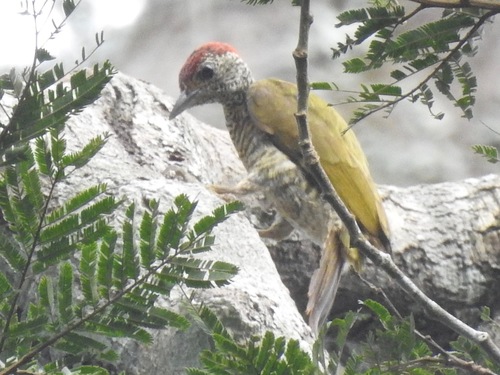 Gabon WoodpeckerDendropicos gabonensisThe Gabon woodpecker is a small woodpecker with a short bill which is quite broad at the base.
 Stierling's WoodpeckerDendropicos stierlingiThis woodpecker grows to a length of about 17.5 cm (7 in).
 Abyssinian WoodpeckerDendropicos abyssinicusThe Abyssinian woodpecker is a very small woodpecker with a relatively long and broad bill.
Learn the Little Grey Woodpecker in the BeakBrain App
Photo and call practice. Coming soon to iPhone and Android.
Play today's Daily BirdEvery photo and recording on this page is credited to its author under the licence shown. Spotted a problem with this page, or have a better photo? Contribute.