Learn what every symbol on the card means.Full credits and sources at beakbrain.com/symbols
 ForestCavity nestSmall · 22 g


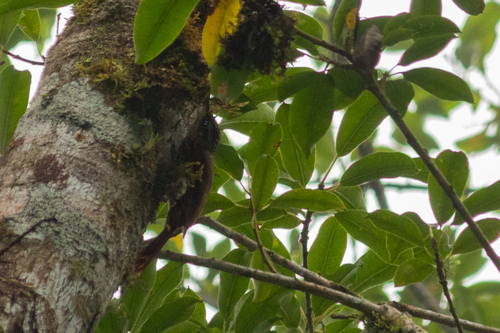
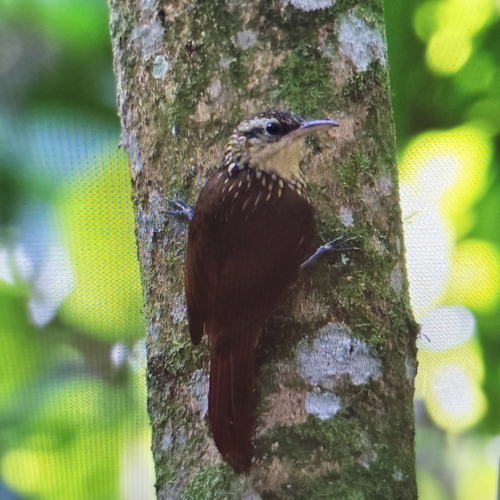
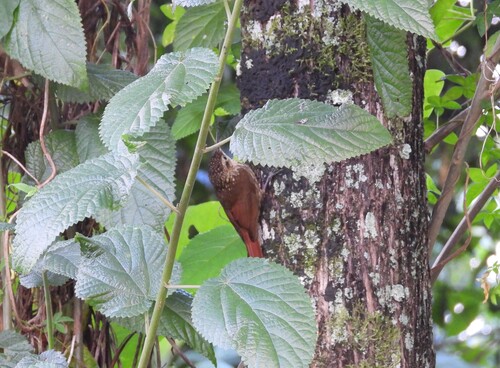
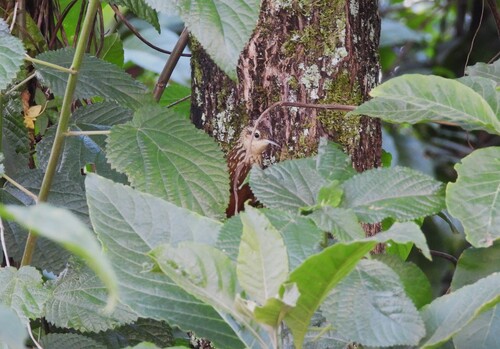
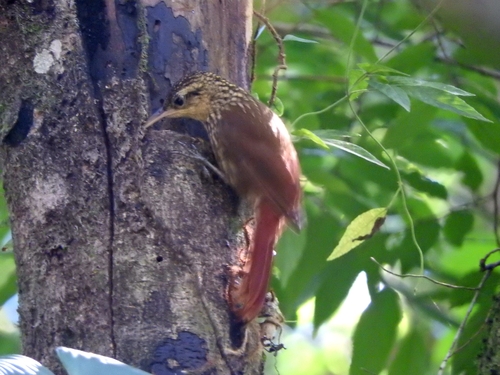

ID tip
The striped woodcreeper is a small, slim member of its genus, with a longish, slim, slightly decurved bill. The species is 15 to 18.5 cm (5.9 to 7.3 in) long and weighs 15.5 to 25 g (0.55 to 0.88 oz). The sexes have the same plumage. Adults of the nominate subspecies have a mostly dusky face with a wide creamy to yellowish buff supercilium and often a pale eyering. Their crown and nape are blackish brown with small yellowish buff to cinnamon spots on the crown. The spots become streaks on the nape and sides of the neck and weakly continue onto the upper back. Voice: The lesser woodcreeper's song is a "fast, sharp rattle, stuttered at end"; the nominate subspecies' song also stutters at the beginning. It has been put into words as "chit, chit, chit, chee-ee-ee-ee-ee-ee-ee, chit, chit-chit." Its calls include a "very high, sharp 'fieet fieet' " and "doubled 'peep, peesp' and single 'speel' or 'wik' ".
Text from Wikipedia, licensed CC BY-SA 4.0.
When to see the Lesser Woodcreeper
One bar for each month, and every month is filled: this bird is recorded here in all twelve. The wide bar is October, the month with the most records.
Where to see the Lesser Woodcreeper
The map shades 3 countries with regular records. Everything unshaded has no records. Countries are listed below the map.
About the Lesser Woodcreeper
The lesser woodcreeper is a species of bird in the subfamily Dendrocolaptinae of the ovenbird family Furnariidae. It is found in Argentina, Brazil, and Paraguay.
Text adapted from Wikipedia, licensed CC BY-SA 4.0.
Easily confused with
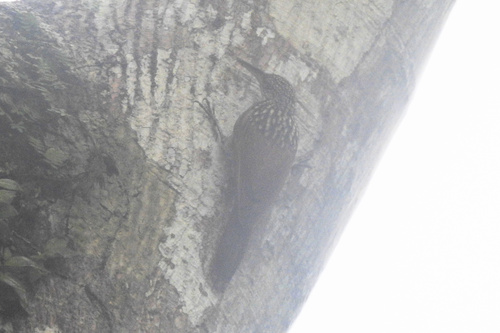 Black-striped WoodcreeperXiphorhynchus lachrymosusThe black-striped woodcreeper is 21.5 to 25 cm (8.5 to 9.8 in) long and weighs 51 to 66 g (1.8 to 2.3 oz).
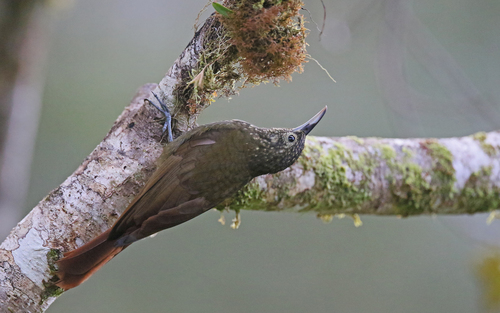 Olive-backed WoodcreeperXiphorhynchus triangularisThe olive-backed woodcreeper is 19.5 to 25 cm (7.7 to 9.8 in) long, males weigh 40 to 52 g (1.4 to 1.8 oz) and females 32 to 48 g (1.1 to 1.7 oz).
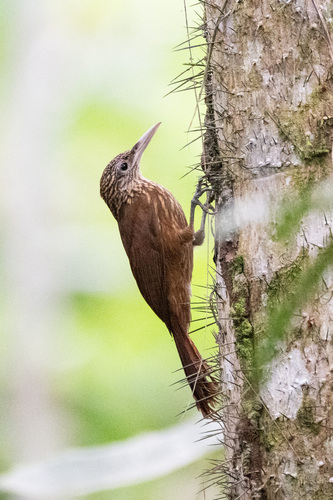 Buff-throated WoodcreeperXiphorhynchus guttatusThe buff-throated woodcreeper is 22.5 to 29.5 cm (8.9 to 12 in) long and weighs 45 to 74 g (1.6 to 2.6 oz).
Side by side: Lesser Woodcreeper vs Spotted Woodcreeper · Black-striped Woodcreeper vs Lesser Woodcreeper · Lesser Woodcreeper vs Olive-backed Woodcreeper
Learn the Lesser Woodcreeper in the BeakBrain App
Photo and call practice. Coming soon to iPhone and Android.
Play today's Daily BirdEvery photo and recording on this page is credited to its author under the licence shown. Spotted a problem with this page, or have a better photo? Contribute.