Learn what every symbol on the card means.Full credits and sources at beakbrain.com/symbols
 ForestCup nest28 g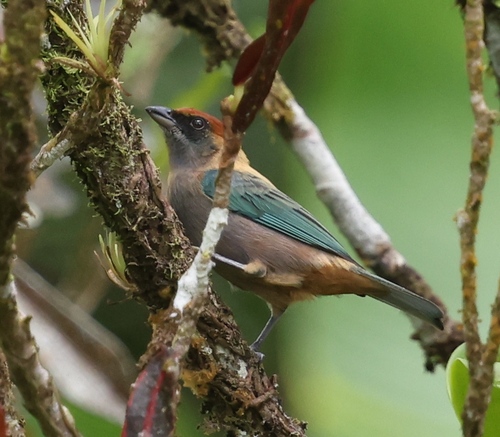


ID tip
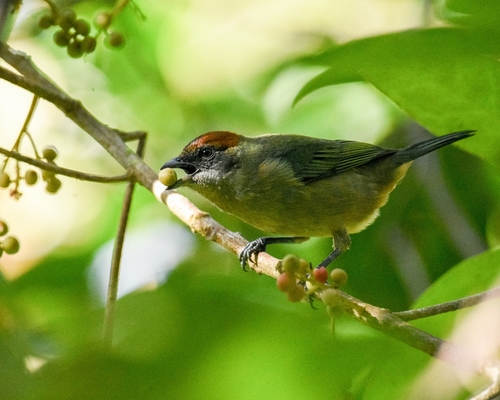
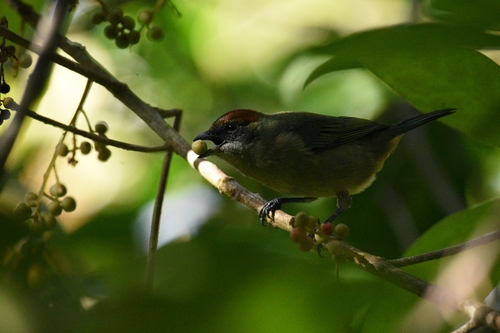
Lesser Antillean tanagers grow to a length of 14–15 cm (5.5–5.9 in). Males are largely buff-colored, with yellowish-buff backs from the neck down to the rump and lavender-buff underparts with dark mottling on the throat. The top of the head is purplish-chestnut and there is a blackish mask across the eyes. The wings and tail feathers are blackish with blue-green margins, while the undertail coverts are tawny-buff. Females are paler and more greenish than males. Juveniles are duller than adults and have very indistinct masks and crowns.
Text from Wikipedia, licensed CC BY-SA 4.0.
When to see the Lesser Antillean Tanager
One bar for each month, and every month is filled: this bird is recorded here in all twelve. The wide bar is May, the month with the most records.
Where to see the Lesser Antillean Tanager
The map shades 2 countries with regular records. Everything unshaded has no records. Countries are listed below the map.
About the Lesser Antillean Tanager
The Lesser Antillean tanager is a species of bird in the family Thraupidae. Males are largely buff-colored, with purplish-chestnut crowns, blackish masks, and blue-green-edged blackish wings. The tanager is only found in Grenada and Saint Vincent. It inhabits a number of habitats, including rainforests, dry forests, humid forests, secondary growth, woodland edge, and gardens. It is omnivorous.
Text adapted from Wikipedia, licensed CC BY-SA 4.0.
Easily confused with
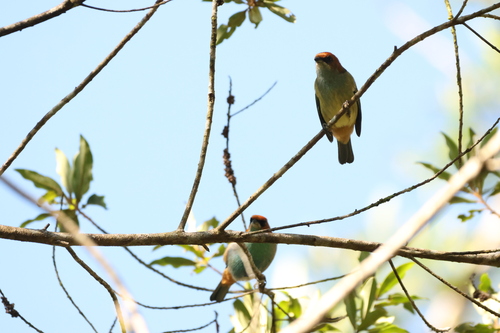 Black-backed TanagerStilpnia peruvianaThe black-backed tanager is a bird species in the Thraupidae family.
 Straw-backed TanagerStilpnia argyrofengesThe straw-backed tanager, also known as the green-throated tanager, is a species of bird in the tanager family.
Green-capped TanagerStilpnia meyerdeschauenseeiThe green-capped tanager is a species of bird in the family Thraupidae.
Straw-backed TanagerStilpnia argyrofengesThe straw-backed tanager, also known as the green-throated tanager, is a species of bird in the tanager family.
Green-capped TanagerStilpnia meyerdeschauenseeiThe green-capped tanager is a species of bird in the family Thraupidae.
Learn the Lesser Antillean Tanager in the BeakBrain App
Photo and call practice. Coming soon to iPhone and Android.
Play today's Daily BirdEvery photo and recording on this page is credited to its author under the licence shown. Spotted a problem with this page, or have a better photo? Contribute.