Learn what every symbol on the card means.Full credits and sources at beakbrain.com/symbols
 ShrublandCup nestSmall · 41 g


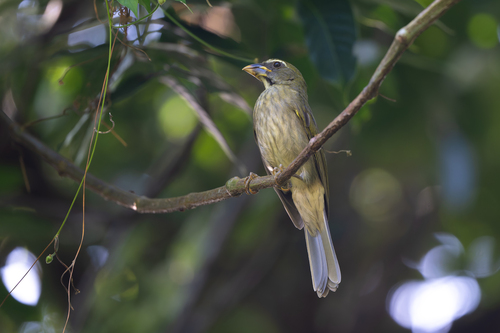
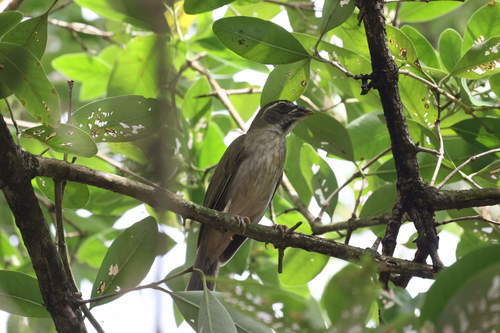
ID tip
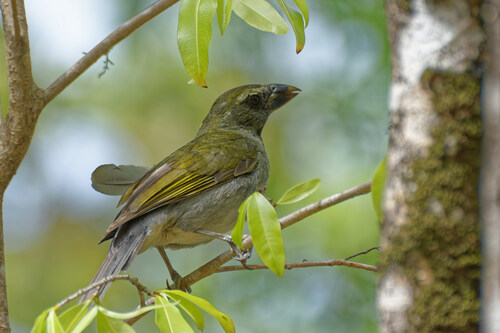
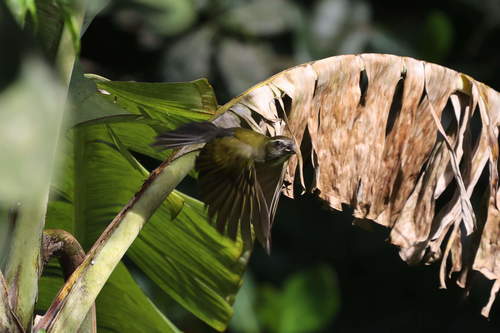
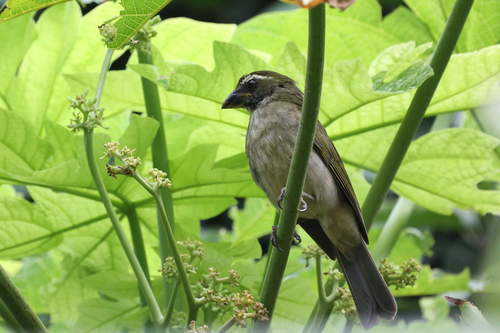
Lesser Antillean saltators grow to a length of 21–22 cm (8.3–8.7 in) and a weight of 37–51.6 g (1.31–1.82 oz). They are olive-green from the back to the top of the head, with a greyish lower back and rump. The face is greyish, with a thin greenish-white supercilium. The beak is black with a yellow gape and apex. The throat is greenish-white, the chest is olive-green, and the flanks are grey. The species does not show sexual dimorphism.
Text from Wikipedia, licensed CC BY-SA 4.0.
When to see the Lesser Antillean Saltator
One bar for each month. Filled bars are the 10 months with records; pale bars are months with none. The wide bar is April, the month with the most records.
Where to see the Lesser Antillean Saltator
The map shades 5 countries with regular records, and 1 more in a lighter tone where the bird turns up only as a stray. Everything unshaded has no records. Countries are listed below the map.
Recorded as a rare visitor in Ecuador.
About the Lesser Antillean Saltator
The Lesser Antillean saltator is a species of songbird in the tanager family Thraupidae that is found in Dominica, Martinique, Saint Kitts and Nevis, and Saint Lucia. Its natural habitats are subtropical or tropical dry forests and heavily degraded former forest.
Text adapted from Wikipedia, licensed CC BY-SA 4.0.
Easily confused with
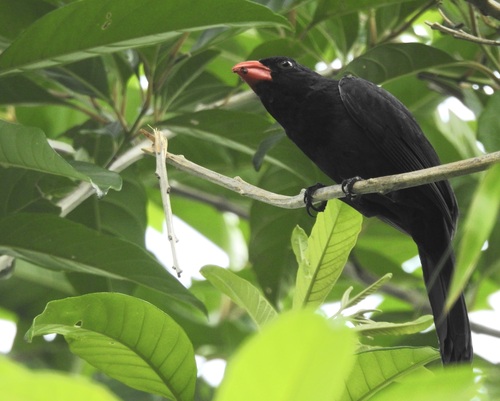 Black-throated GrosbeakSaltator fuliginosusThe black-throated grosbeak is a seed-eating passerine bird in the tanager family Thraupidae.
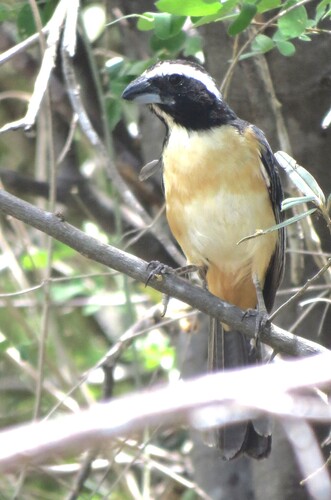 Orinoco SaltatorSaltator orenocensisThe Orinoco saltator or Orinocan saltator is a species of saltator in the family Thraupidae.
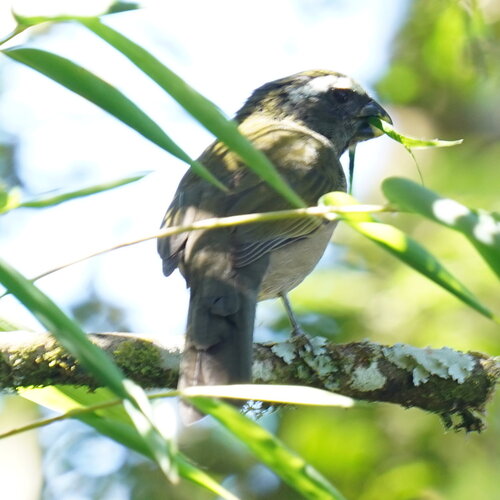 Thick-billed SaltatorSaltator maxillosusMeasures about 19 centimeters.
Learn the Lesser Antillean Saltator in the BeakBrain App
Photo and call practice. Coming soon to iPhone and Android.
Play today's Daily BirdEvery photo and recording on this page is credited to its author under the licence shown. Spotted a problem with this page, or have a better photo? Contribute.