Learn what every symbol on the card means.Full credits and sources at beakbrain.com/symbols
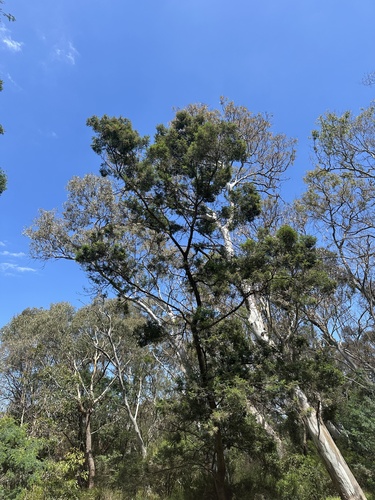
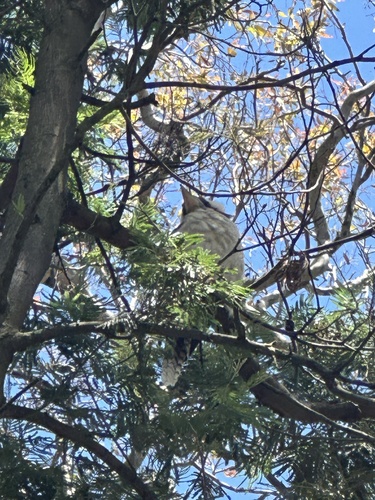
 ForestCavity nestLarge · 334 g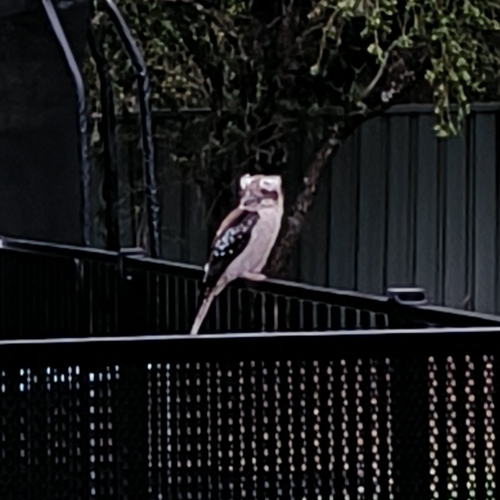
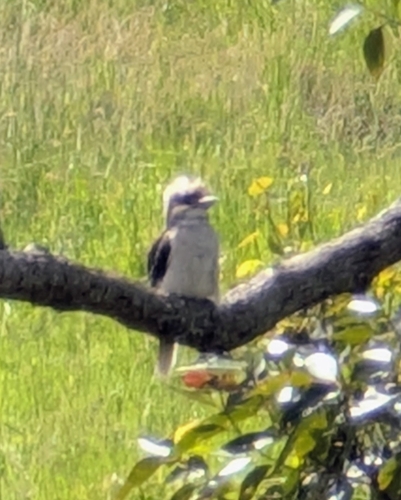
ID tip
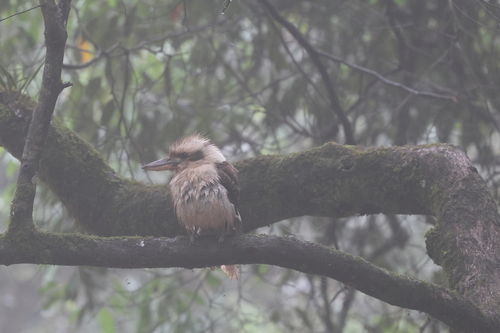
The laughing kookaburra is the largest species of kingfisher, outsizing even the giant kingfisher in body mass. It is a stout, stocky bird 41–47 cm (16–19 in) in length, with a large head, prominent brown eyes, and a long and robust bill. The sexes are very similar, although the female is usually larger and has less blue to the rump than the male. The male weighs 196–450 g (6.9–15.9 oz), mean 307 g (10.8 oz) and the female 190–465 g (6.7–16.4 oz), mean 352 g (12.4 oz). Voice: The name "laughing kookaburra" refers to the bird's "laugh", which it uses to establish territory among family groups. It can be heard at any time of day, but most frequently at dawn and dusk. This species possesses a tracheo-bronchial syrinx, which creates two sources of vibrations so it can produce two frequencies at the same time with multiple harmonics.
Text from Wikipedia, licensed CC BY-SA 4.0.
When to see the Laughing Kookaburra
One bar for each month, and every month is filled: this bird is recorded here in all twelve. The wide bar is October, the month with the most records.
Where to see the Laughing Kookaburra
The map shades 2 countries with regular records, and 4 more in a lighter tone where the bird turns up only as a stray. Everything unshaded has no records. Countries are listed below the map.
Recorded as a rare visitor in Belgium, United Kingdom, United States, Germany.
About the Laughing Kookaburra
The laughing kookaburra is a bird in the kingfisher subfamily Halcyoninae. It is a large kingfisher with a whitish head and a brown eye-stripe. The upperparts are mostly dark brown but there is a mottled light-blue patch on the wing coverts. The underparts are cream-white and the tail is barred with rufous and black. The plumage of the male and female birds is similar. The territorial call is a distinctive laugh that is often delivered by several birds at the same time, and is widely used as a stock sound effect in situations that involve a jungle setting.
Text adapted from Wikipedia, licensed CC BY-SA 4.0.
Easily confused with
 Blue-winged KookaburraDacelo leachiiThe adult blue-winged kookaburra measures around 38 to 42 cm (15 to 17 in) in length and weighs 260 to 330 g.
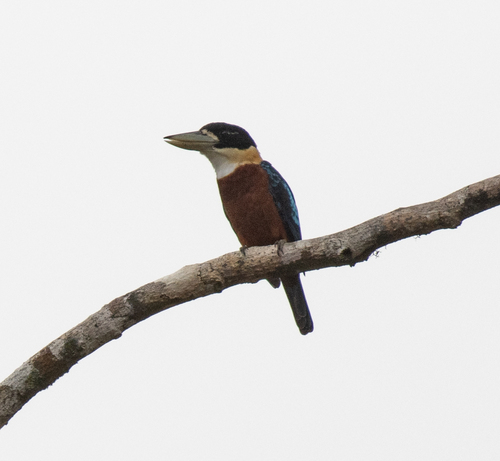 Rufous-bellied KookaburraDacelo gaudichaudThe rufous-bellied kookaburra, originally known as Gaudichaud's kookaburra after French botanist Charles Gaudichaud-Beaupré, is a species of kookaburra that is widely distributed through the forests of lowland New Guinea.
Shovel-billed KookaburraDacelo rexThe shovel-billed kookaburra, also known as the shovel-billed kingfisher, is a large, approximately 33 cm (13 in) long, dark brown tree kingfisher with a heavy, short, and broad bill that is unique among the kingfishers.
Rufous-bellied KookaburraDacelo gaudichaudThe rufous-bellied kookaburra, originally known as Gaudichaud's kookaburra after French botanist Charles Gaudichaud-Beaupré, is a species of kookaburra that is widely distributed through the forests of lowland New Guinea.
Shovel-billed KookaburraDacelo rexThe shovel-billed kookaburra, also known as the shovel-billed kingfisher, is a large, approximately 33 cm (13 in) long, dark brown tree kingfisher with a heavy, short, and broad bill that is unique among the kingfishers.
Side by side: Blue-winged Kookaburra vs Laughing Kookaburra
Learn the Laughing Kookaburra in the BeakBrain App
Photo and call practice. Coming soon to iPhone and Android.
Play today's Daily BirdEvery photo and recording on this page is credited to its author under the licence shown. Spotted a problem with this page, or have a better photo? Contribute.