Learn what every symbol on the card means.Full credits and sources at beakbrain.com/symbols
 GrasslandCup nestSmall · 38 g


ID tip
Lark buntings are small songbirds, with a short, thick, bluish bill. There is a large patch of white on the wings and they have a relatively short tail with white tips at the end of the feathers. Breeding males have an all black body with a large white patch on the upper part of the wing. Nonbreeding males and females look similar and are grayish brown with white stripes. Measurements: Length: 5.5–7.1 in (140–180 mm) Weight: 1.3–1.5 oz (37–43 g) Wingspan: 9.8–11.0 in (250–280 mm)
Text from Wikipedia, licensed CC BY-SA 4.0.
When to see the Lark Bunting
One bar for each month. Filled bars are the 11 months with records; pale bars are months with none. The wide bar is May, the month with the most records.
Where to see the Lark Bunting
The map shades 3 countries with regular records. Everything unshaded has no records. Countries are listed below the map.
About the Lark Bunting
The lark bunting is a medium-sized American bunting native to central and western North America. It was designated the state bird of Colorado in 1931.
Text adapted from Wikipedia, licensed CC BY-SA 4.0.
Easily confused with
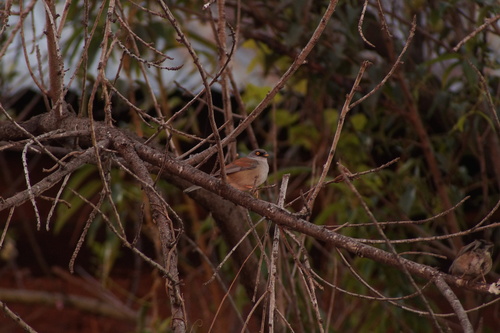 Yellow-eyed JuncoJunco phaeonotusThe yellow-eyed junco is about 16 cm (6.3 in) long.
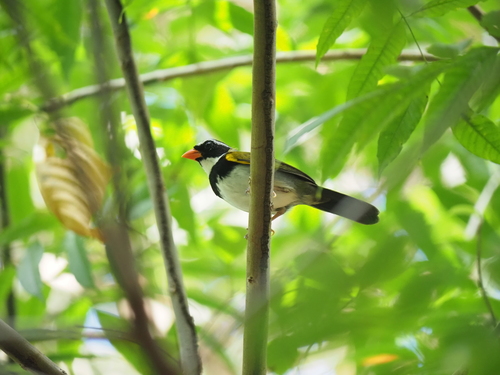 Orange-billed SparrowArremon aurantiirostrisThe orange-billed sparrow is 14.5 to 16.5 cm (5.7 to 6.5 in) long and weighs about 35 g (1.2 oz).
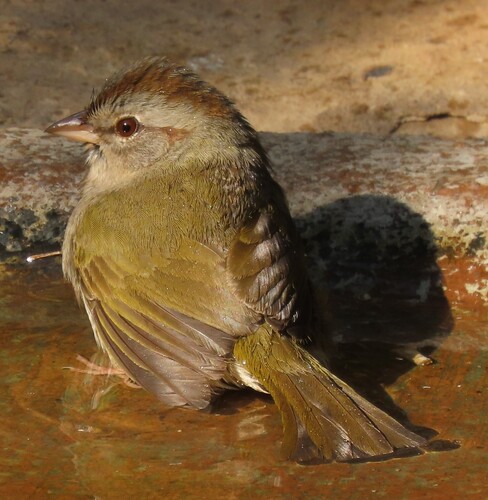 Olive SparrowArremonops rufivirgatusThe olive sparrow is about 12 to 14 cm (4.7 to 5.5 in) long and weighs 15 to 30 g (0.53 to 1.1 oz).
Side by side: Lark Bunting vs Olive Sparrow · Lark Bunting vs Yellow-eyed Junco · Lark Bunting vs Orange-billed Sparrow
Learn the Lark Bunting in the BeakBrain App
Photo and call practice. Coming soon to iPhone and Android.
Play today's Daily BirdEvery photo and recording on this page is credited to its author under the licence shown. Spotted a problem with this page, or have a better photo? Contribute.