Learn what every symbol on the card means.Full credits and sources at beakbrain.com/symbols
 WetlandPlatform nestLarge · 643 g






ID tip
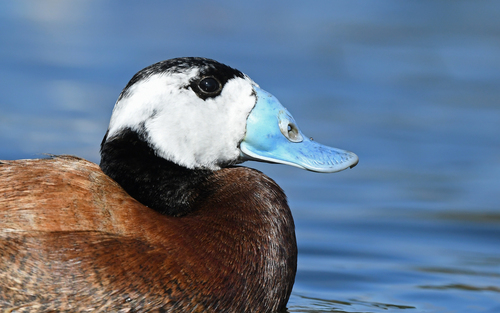
The lake duck grows to 36–46 centimetres (14–18 in). Females weigh 510–700 grams (18–25 oz) and males 600–850 grams (21–30 oz). Males can be distinguished from Andean duck (Oxyura ferruginea), a similar species, by being smaller and having a flatter head.
Text from Wikipedia, licensed CC BY-SA 4.0.
When to see the Lake Duck
One bar for each month, and every month is filled: this bird is recorded here in all twelve. The wide bar is October, the month with the most records.
Where to see the Lake Duck
The map shades 5 countries with regular records, and 2 more in a lighter tone where the bird turns up only as a stray. Everything unshaded has no records. Countries are listed below the map.
Recorded as a rare visitor in United Kingdom, Bolivia.
About the Lake Duck
The lake duck is a small, South American stiff-tailed duck. It is also called the Argentine blue-bill, Argentine blue-billed duck, Argentine lake duck, or Argentine ruddy duck.
Text adapted from Wikipedia, licensed CC BY-SA 4.0.
Easily confused with
 White-headed DuckOxyura leucocephalaAdult males have a grey and reddish body, a blue bill and a largely white head with a black cap and neck.
 Blue-billed DuckOxyura australisThe tail feathers for both the male and female are made up of thick, spine-like shafts.
 Maccoa DuckOxyura maccoaAs members of the stiff-tailed duck group, Maccoas are often found wading in the water with their tail feathers cocked upwards.
Side by side: Lake Duck vs Ruddy Duck · Blue-billed Duck vs Lake Duck · Lake Duck vs White-headed Duck · Lake Duck vs Radjah Shelduck · Lake Duck vs Maccoa Duck
Learn the Lake Duck in the BeakBrain App
Photo and call practice. Coming soon to iPhone and Android.
Play today's Daily BirdEvery photo and recording on this page is credited to its author under the licence shown. Spotted a problem with this page, or have a better photo? Contribute.