Learn what every symbol on the card means.Full credits and sources at beakbrain.com/symbols
 ForestCavity nestMedium · 62 g


ID tip
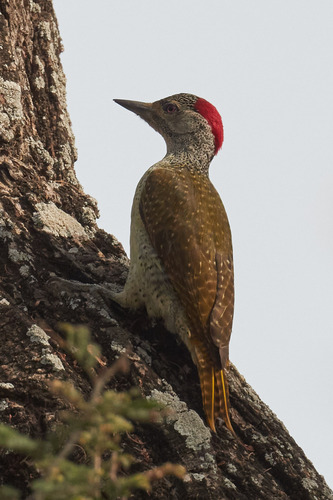
This species is distinguished from the other South African woodpeckers by its thickly spotted under-surface which is covered with black spots from the chin to the vent. Males and females differ slightly. Males have an olive-green color above with indistinct, small transverse bars and a few diamond-shaped sub-terminal spots that are a paler olive-yellow. The female Knysna woodpecker is similar to the male, but the black head is spotted with white and only the occiput is scarlet. The quills are brown, except for near the base where they are externally olive.
Text from Wikipedia, licensed CC BY-SA 4.0.
When to see the Knysna Woodpecker
One bar for each month, and every month is filled: this bird is recorded here in all twelve. The wide bar is December, the month with the most records.
Where to see the Knysna Woodpecker
The map shades 1 country with regular records. Everything unshaded has no records. Countries are listed below the map.
About the Knysna Woodpecker
The Knysna woodpecker is a species of bird in the family Picidae. It is endemic to South Africa, where its natural habitats are subtropical or tropical moist lowland forests, moist savanna, and subtropical or tropical moist shrubland. It is threatened by habitat loss. It belongs to a species complex that includes the golden-tailed and Mombasa woodpeckers.
Text adapted from Wikipedia, licensed CC BY-SA 4.0.
Easily confused with
 Bennett's WoodpeckerCampethera bennettiiBennett's woodpecker is about 24 cm (9.4 in) long and weighs 61–84 g (2.2–3.0 oz).
 Nubian WoodpeckerCampethera nubicaThe Nubian woodpecker Is a medium-sized species growing to a length of about 21 cm (8.3 in).
 Fine-spotted WoodpeckerCampethera punctuligeraThis bird is 22 cm (8.7 in) in length.
Side by side: Golden-tailed Woodpecker vs Knysna Woodpecker · Knysna Woodpecker vs Nubian Woodpecker · Bennett's Woodpecker vs Knysna Woodpecker
Learn the Knysna Woodpecker in the BeakBrain App
Photo and call practice. Coming soon to iPhone and Android.
Play today's Daily BirdEvery photo and recording on this page is credited to its author under the licence shown. Spotted a problem with this page, or have a better photo? Contribute.