Learn what every symbol on the card means.Full credits and sources at beakbrain.com/symbols
 Forest

ID tip
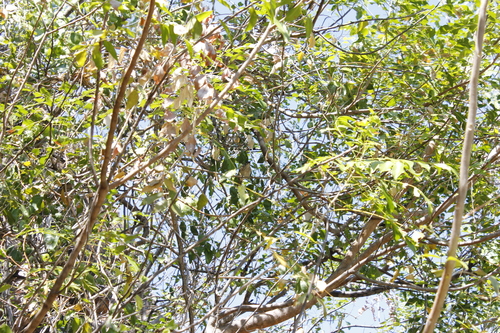
The Kimberley honeyeater is similar in appearance to the white-lined honeyeater, having dark grey upperparts, light grey underparts, grey eyes, with dark grey below the eyes and a black beak. It is distinguished from the white-lined honeyeater by the lack of citrine edging on the upper surface of the remiges and rectrices, pale creamy-buff under-wing coverts, and a milky-white belly.
Text from Wikipedia, licensed CC BY-SA 4.0.
When to see the Kimberley Honeyeater
One bar for each month. Filled bars are the 6 months with records; pale bars are months with none. The wide bar is July, the month with the most records.
Where to see the Kimberley Honeyeater
The map shades 1 country with regular records. Everything unshaded has no records. Countries are listed below the map.
About the Kimberley Honeyeater
The Kimberley honeyeater is a bird in the honeyeater family, Meliphagidae. It was formerly lumped with the white-lined honeyeater but, based on a genetic analysis, it is now considered a separate species. Articles published in 2014 and 2015 provided evidence that the Kimberley and white-lined honeyeaters differ not only genetically, but also in song and foraging ecology. The specific epithet honours the Australian chemist and ornithologist Dr Julian Ralph Ford (1932-1987).
Text adapted from Wikipedia, licensed CC BY-SA 4.0.
Easily confused with
 Yellow-gaped HoneyeaterMeliphaga flavirictusThe yellow-gaped honeyeater is a species of bird in the family Meliphagidae.
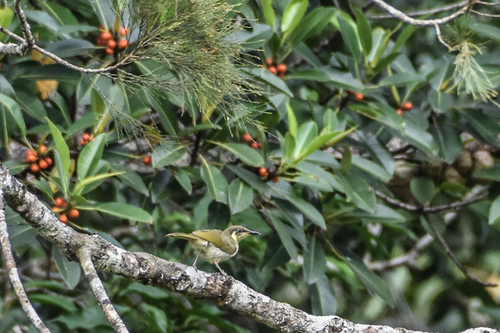 Elegant HoneyeaterMeliphaga cinereifronsThe elegant honeyeater is a species of bird in the family Meliphagidae.
 Forest HoneyeaterMeliphaga montanaThe forest honeyeater is a species of bird in the family Meliphagidae.
Learn the Kimberley Honeyeater in the BeakBrain App
Photo and call practice. Coming soon to iPhone and Android.
Play today's Daily BirdEvery photo and recording on this page is credited to its author under the licence shown. Spotted a problem with this page, or have a better photo? Contribute.