Learn what every symbol on the card means.Full credits and sources at beakbrain.com/symbols
 ShrublandCup nestSmall · 20 g

ID tip
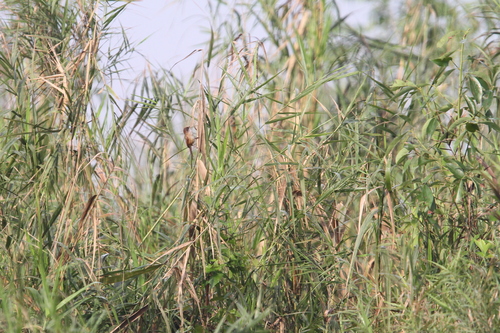
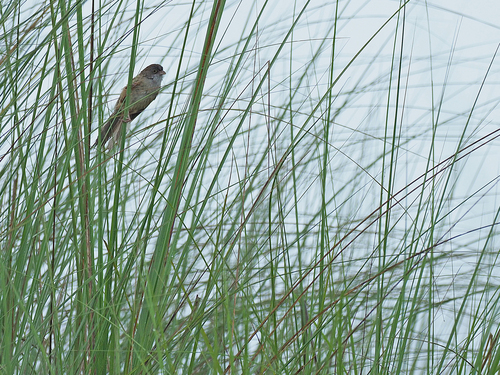
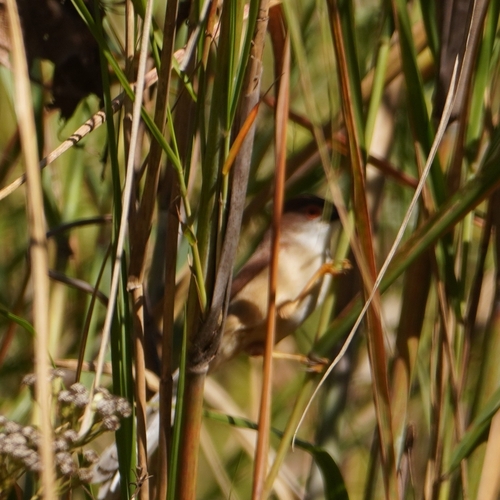
Measuring 16–17 cm in length, it is quite intermediate in habitus between certain typical warblers (Sylvia) and the parrotbills (Paradoxornis). Like these, it is a drab bird with a long tail used to balance when creeping through the vegetation; its bill is thicker than in Sylvia but not as heavy as in Paradoxornis. Buffy chestnut brown above and a slightly lighter yellowish-brown on the belly, its lores are pale greyish, as are the throat and breast. The tail and a wing patch are redder than the rest of the upperside.
Text from Wikipedia, licensed CC BY-SA 4.0.
When to see the Jerdon's Babbler
One bar for each month. Filled bars are the 7 months with records; pale bars are months with none. The wide bar is April, the month with the most records.
Where to see the Jerdon's Babbler
The map shades 3 countries with regular records, and 1 more in a lighter tone where the bird turns up only as a stray. Everything unshaded has no records. Countries are listed below the map.
Recorded as a rare visitor in Pakistan.
About the Jerdon's Babbler
Jerdon's babbler is a passerine bird native to wetlands and grasslands of the Indian sub-continent. It is listed as Vulnerable on the IUCN Red List since 1994. It is a member of the genus Chrysomma of the family Paradoxornithidae.
Text adapted from Wikipedia, licensed CC BY-SA 4.0.
Easily confused with
Learn the Jerdon's Babbler in the BeakBrain App
Photo and call practice. Coming soon to iPhone and Android.
Play today's Daily BirdEvery photo and recording on this page is credited to its author under the licence shown. Spotted a problem with this page, or have a better photo? Contribute.