Learn what every symbol on the card means.Full credits and sources at beakbrain.com/symbols
 ForestDomed nestTiny · 11 g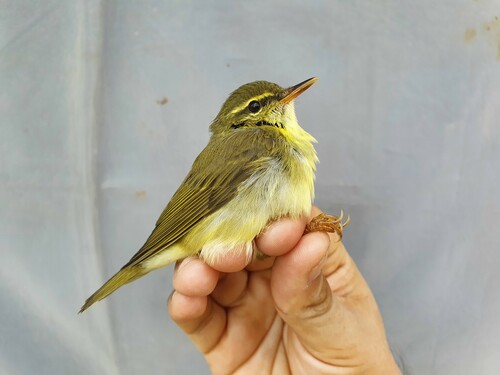


ID tip
The Japanese Leaf-Warbler is sized between 12–13 cm in length. They typically have darker green upper body feathers, with an under body (or belly) with lighter green feathers. They have a very short and black (with a hint of yellow) beak, as well as extremely small legs that vary from pale yellow to orange-brown. The bird has a clear yellowish-white eyebrow stripe above the bird's dark eyes. Adults are bright olive-green (with a white wingbar and greenish tail). Both sexes look alike. Juveniles are roughly similar, yet duller in color (more grey-brown).
Text from Wikipedia, licensed CC BY-SA 4.0.
When to see the Japanese Leaf Warbler
One bar for each month. Filled bars are the 6 months with records; pale bars are months with none. The wide bar is May, the month with the most records.
Where to see the Japanese Leaf Warbler
The map shades 5 countries with regular records, and 2 more in a lighter tone where the bird turns up only as a stray. Everything unshaded has no records. Countries are listed below the map.
About the Japanese Leaf Warbler
The Japanese leaf warbler is a leaf warbler. The species was first described by Robert Swinhoe in 1863. It was formerly included in the "Old World warbler" assemblage. It is closely related to the Arctic warbler and the Kamchatka leaf warbler, to which it was formerly considered conspecific.
Text adapted from Wikipedia, licensed CC BY-SA 4.0.
Easily confused with
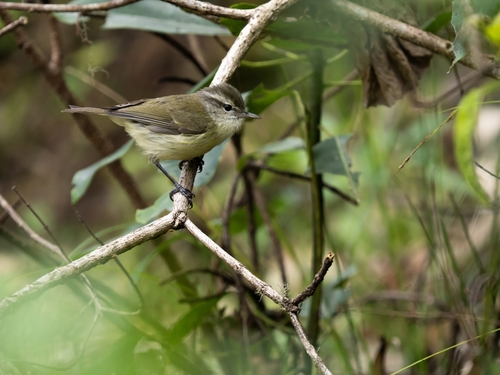 Timor Leaf WarblerPhylloscopus presbytesThe Timor leaf warbler is a species of Old World warbler in the family Phylloscopidae.
 Philippine Leaf WarblerPhylloscopus olivaceusThe Philippine leaf warbler is a species of Old World warbler in the family Phylloscopidae.
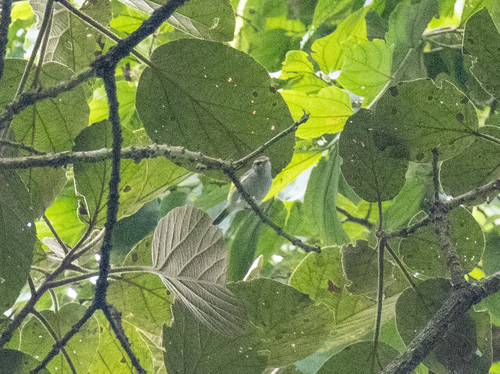 Uganda Woodland WarblerPhylloscopus budongoensisThe Uganda woodland warbler is a species of Old World warbler in the family Phylloscopidae.
Learn the Japanese Leaf Warbler in the BeakBrain App
Photo and call practice. Coming soon to iPhone and Android.
Play today's Daily BirdEvery photo and recording on this page is credited to its author under the licence shown. Spotted a problem with this page, or have a better photo? Contribute.