Learn what every symbol on the card means.Full credits and sources at beakbrain.com/symbols
 ForestCavity nestLarge · 338 g


ID tip
The overall appearance is sooty-grey, not at all glossy, like its relatives; though it does possess a similar dark grey patch of naked skin just behind the eye, and a smaller naked patch at the base of the bill. The bill itself is slate-grey and quite deep, tapering to a sharp point. The nasal bristles are relatively sparse usually leaving the nostrils on view. The iris is either grey-brown or red-brown, possibly depending on age. The legs and feet are black.
Text from Wikipedia, licensed CC BY-SA 4.0.
When to see the Jamaican Crow
One bar for each month. Filled bars are the 7 months with records; pale bars are months with none. The wide bar is March, the month with the most records.
Where to see the Jamaican Crow
The map shades 1 country with regular records. Everything unshaded has no records. Countries are listed below the map.
About the Jamaican Crow
The Jamaican crow is a comparatively small corvid. It shares several key morphological features with two other West Indian species, the Cuban crow and the white-necked crow of Hispaniola, which are very closely related to it.
Text adapted from Wikipedia, licensed CC BY-SA 4.0.
Easily confused with
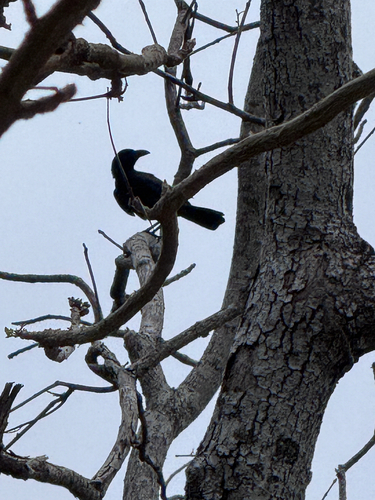 Palawan CrowCorvus pusillusThe Palawan crow is a passerine bird of the family Corvidae, in the genus Corvus.
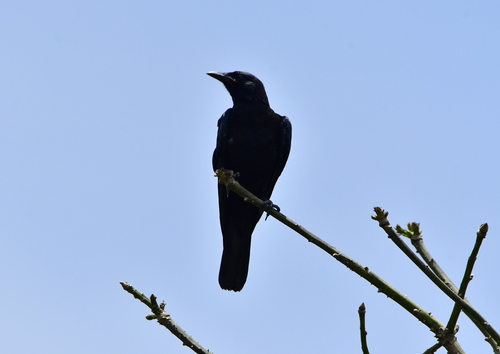 Tamaulipas CrowCorvus imparatusIt is a relatively small and sleek looking crow, 34–38 centimetres (13–15 in) in length.
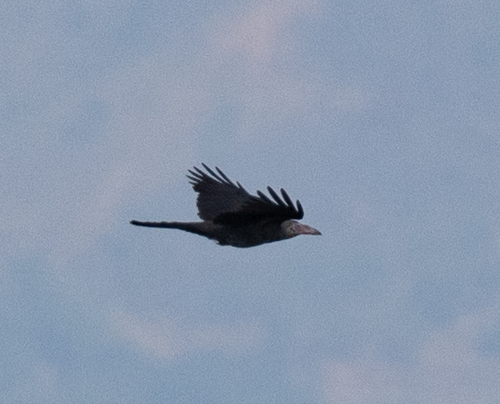 Grey CrowCorvus tristisThe gray crow, formerly known as the bare-faced crow, is about the same size as the Eurasian carrion crow but has somewhat different proportions and quite atypical feather pigmentation during the juvenile phase for a member of this genus.
Learn the Jamaican Crow in the BeakBrain App
Photo and call practice. Coming soon to iPhone and Android.
Play today's Daily BirdEvery photo and recording on this page is credited to its author under the licence shown. Spotted a problem with this page, or have a better photo? Contribute.