Learn what every symbol on the card means.Full credits and sources at beakbrain.com/symbols
 WoodlandCup nestTiny · 15 g


ID tip
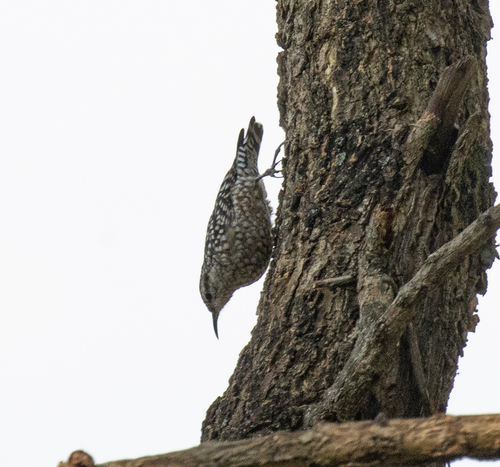
The Indian spotted creeper has grey and white spotted and barred plumage, clearly different from the treecreepers of the family Certhiidae. It weighs up to 16 grams, twice as much as treecreepers of similar length (up to 15 cm). The Indian spotted creeper has a thin pointed down-curved bill, a bit longer than the head, that it uses to extricate insects from bark, but it lacks the stiff tail feathers which treecreepers use to prop themselves on the vertical surface of tree trunks. They have a whitish supercilium contrasting with a dark eye stripe and white on the throat.
Text from Wikipedia, licensed CC BY-SA 4.0.
When to see the Indian Spotted Creeper
One bar for each month. Filled bars are the 10 months with records; pale bars are months with none. The wide bar is October, the month with the most records.
Where to see the Indian Spotted Creeper
The map shades 6 countries with regular records. Everything unshaded has no records. Countries are listed below the map.
About the Indian Spotted Creeper
The Indian spotted creeper is a small passerine bird that is a member of the family Salpornithidae, which was previously treated as a subfamily of Certhiidae. This small bird has a marbled black and white plumage that makes it difficult to spot as it forages on the trunks of dark, deeply fissured trees where it picks out insect prey using its curved bill. It is found in patchily distributed localities mainly in the dry scrub and open deciduous forests of northern and central peninsular India. It does not migrate.
Text adapted from Wikipedia, licensed CC BY-SA 4.0.
Easily confused with
Learn the Indian Spotted Creeper in the BeakBrain App
Photo and call practice. Coming soon to iPhone and Android.
Play today's Daily BirdEvery photo and recording on this page is credited to its author under the licence shown. Spotted a problem with this page, or have a better photo? Contribute.