Learn what every symbol on the card means.Full credits and sources at beakbrain.com/symbols
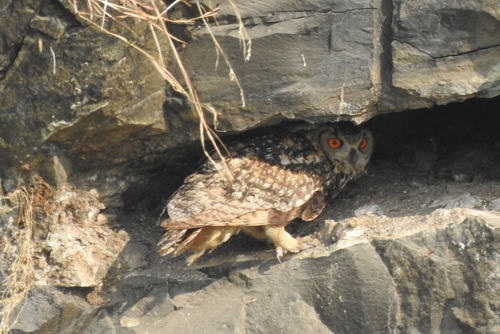
 RockyCavity nestLarge · 1.1 kg



What the Indian Eagle-Owl sounds like

ID tip
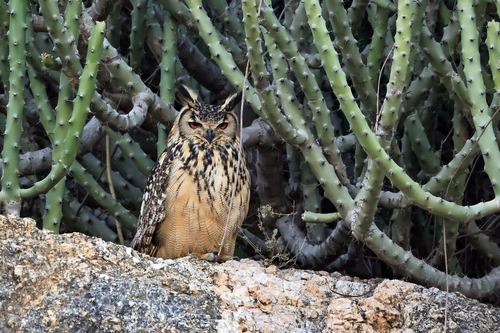
This species is often considered a subspecies of the Eurasian eagle-owl Bubo bubo and is very similar in appearance. The facial disk is unmarked and has a black border, a feature that is much weaker in the Eurasian form. The base of the primaries is unbanded and rufous. The tail bands have the tawny bands wider than the black ones. Additionally, a large pale scapular patch is visible on the folded wing. The inner claws are the longest. The last joint of the toes are unfeathered. The taxonomy of the group is complex due to a large amount of variation.
Text from Wikipedia, licensed CC BY-SA 4.0.
When to see the Indian Eagle-Owl
One bar for each month, and every month is filled: this bird is recorded here in all twelve. The wide bar is February, the month with the most records.
Where to see the Indian Eagle-Owl
The map shades 2 countries with regular records, and 1 more in a lighter tone where the bird turns up only as a stray. Everything unshaded has no records. Countries are listed below the map.
Recorded as a rare visitor in India.
About the Indian Eagle-Owl
The Indian eagle-owl, or the Bengal eagle-owl or rock eagle-owl, is a large horned owl species native to hilly and rocky scrub forests in the Indian subcontinent. It is splashed with brown and grey, and has a white throat patch with black small stripes. It was earlier treated as a subspecies of the Eurasian eagle-owl. It is usually seen in pairs. It has a deep resonant booming call that may be heard at dawn and dusk.
Text adapted from Wikipedia, licensed CC BY-SA 4.0.
Easily confused with
 Arabian Eagle-OwlBubo milesiBubo milesi is a medium-sized owl, visually very similar to the Eurasian eagle-owl (B. bubo) or the Pharaoh eagle-owl (B. ascalaphus) of North Africa, possessing the same "ear"-tufts on its head for improved hearing.
 Pharaoh Eagle-OwlBubo ascalaphusThe Pharaoh eagle-owl has a mottled plumage and large orange-yellow eyes.
 Greyish Eagle-OwlBubo cinerascensThis species is about 43 cm (17 in) long and weighs about 500 g (18 oz).
Learn the Indian Eagle-Owl in the BeakBrain App
Photo and call practice. Coming soon to iPhone and Android.
Play today's Daily BirdEvery photo and recording on this page is credited to its author under the licence shown. Spotted a problem with this page, or have a better photo? Contribute.