Learn what every symbol on the card means.Full credits and sources at beakbrain.com/symbols
 UrbanPlatform nestSmall · 48 g



ID tip
Voice: The song, a forceful cooing rendered variously as cowl-coo, POO-pup, or NO-hope, may be given from a tree, wire, or other open, high perch such as a television aerial.
Text from Wikipedia, licensed CC BY-SA 4.0.
When to see the Inca Dove
One bar for each month, and every month is filled: this bird is recorded here in all twelve. The wide bar is April, the month with the most records.
Where to see the Inca Dove
The map shades 9 countries with regular records, and 1 more in a lighter tone where the bird turns up only as a stray. Everything unshaded has no records. Countries are listed below the map.
Recorded as a rare visitor in Canada.
About the Inca Dove
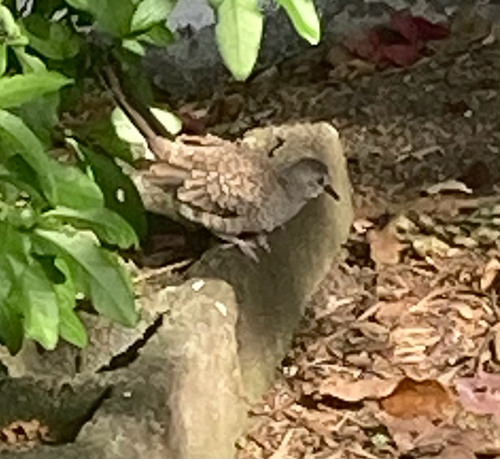
The Inca dove or Mexican dove is a small New World dove. The species was first described by French surgeon and naturalist René Lesson in 1847. It reaches a length of 16.5–23 cm (6.5–9.1 in) and weighs 30–58 g (1.1–2.0 oz). The Inca dove has an average wingspan of 28.5 cm and a max wingspan of 32 cm. It is a slender species, with a gray-brown body covered in feathers that resemble a scaled pattern. The tail is long and square and edged with white feathers that may flare out in flight. The underwings are reddish, like other ground doves, and upon takeoff, the wings produce a distinctive, quiet rattling noise.
Text adapted from Wikipedia, licensed CC BY-SA 4.0.
Easily confused with
 Common Ground DoveColumbina passerinaThe common ground dove is North America's smallest and one of the world's smallest by mass.
 Ruddy Ground DoveColumbina talpacotiIt measures 12–18 cm (4.7–7.1 in) in length and weighs about 35–56 g (1.2–2.0 oz).
 Picui Ground DoveColumbina picuiThe Picui ground dove is 18 cm (7.1 in) long and weighs 42 to 59 g (1.5 to 2.1 oz).
Side by side: Inca Dove vs Ruddy Ground Dove · Common Ground Dove vs Inca Dove · Crested Pigeon vs Inca Dove · Inca Dove vs Picui Ground Dove
Learn the Inca Dove in the BeakBrain App
Photo and call practice. Coming soon to iPhone and Android.
Play today's Daily BirdEvery photo and recording on this page is credited to its author under the licence shown. Spotted a problem with this page, or have a better photo? Contribute.