Learn what every symbol on the card means.Full credits and sources at beakbrain.com/symbols
 MarineCavity nestHuge · 4.4 kg


ID tip
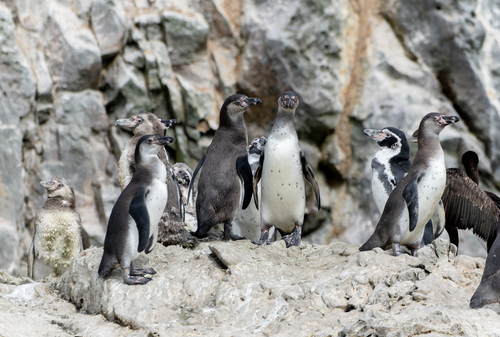
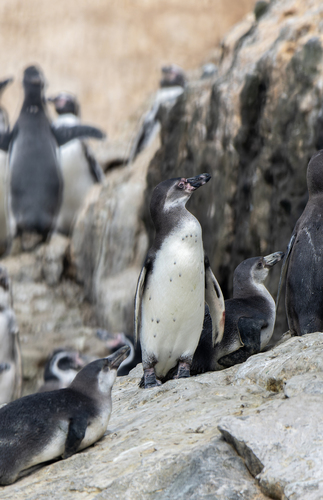
Humboldt penguins are medium-sized penguins, growing to 56–70 cm (22–28 in) long and a weight of 2.9 to 6 kg (6.4 to 13.2 lb). The sex of the Humboldt penguin cannot be recognised via differences in plumage, as they are monomorphic. The male is heavier and larger than the females. Their sex can be determined via head width and bill length; the male has a longer bill than the female. While all the Spheniscus penguins are close to each other in size, the Humboldt penguin is the heaviest species in the genus, with 123 females weighing 4.05 kg (8.9 lb) on average and 165 males averaging 4. Voice: The Humboldt penguin has different calls that it uses to communicate in different ways. The function of its calls are consistent among Spheniscus species. If an individual comes too close to an adult Humboldt penguin, the Yell is a warning call which is followed by pecking or chasing if ignored.
Text from Wikipedia, licensed CC BY-SA 4.0.
When to see the Humboldt Penguin
One bar for each month, and every month is filled: this bird is recorded here in all twelve. The wide bar is November, the month with the most records.
Where to see the Humboldt Penguin
The map shades 3 countries with regular records, and 2 more in a lighter tone where the bird turns up only as a stray. Everything unshaded has no records. Countries are listed below the map.
About the Humboldt Penguin
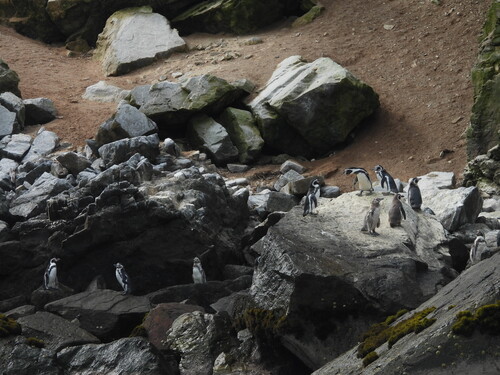
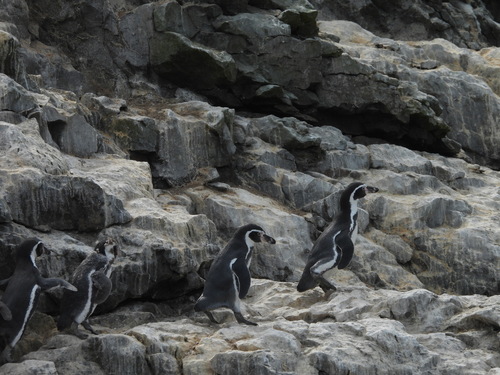
The Humboldt penguin is a medium-sized penguin. It resides in South America, along the Pacific coast of Peru and Chile. Its nearest relatives are the African penguin, the Magellanic penguin and the Galápagos penguin. The Humboldt penguin and the cold water current it swims in are both named after the explorer Alexander von Humboldt. The species is listed as vulnerable by the IUCN with no population recovery plan in place. The current wild population is composed of roughly 23,800 mature individuals and is declining. It is a migrant species.
Text adapted from Wikipedia, licensed CC BY-SA 4.0.
Easily confused with
 African PenguinSpheniscus demersusAfrican penguins grow to 60–70 cm (24–28 in) tall and weigh between 2.2–3.5 kg (4.9–7.7 lb).
 Galapagos PenguinSpheniscus mendiculusThe average Galápagos penguin is 48–50 centimetres (19–20 in) tall and weighs around 2–4 kilograms (4.4–8.8 lb).
 Magellanic PenguinSpheniscus magellanicusMagellanic penguins are medium-sized penguins which grow to be 61–76 cm (24–30 in) tall and weigh between 2.7 and 6.5 kg (6.0 and 14.3 lb).
Side by side: Humboldt Penguin vs Little Penguin · Humboldt Penguin vs Magellanic Penguin · African Penguin vs Humboldt Penguin · Galapagos Penguin vs Humboldt Penguin
Learn the Humboldt Penguin in the BeakBrain App
Photo and call practice. Coming soon to iPhone and Android.
Play today's Daily BirdEvery photo and recording on this page is credited to its author under the licence shown. Spotted a problem with this page, or have a better photo? Contribute.