Learn what every symbol on the card means.Full credits and sources at beakbrain.com/symbols
 WetlandPlatform nestHuge · 3.1 kg




ID tip
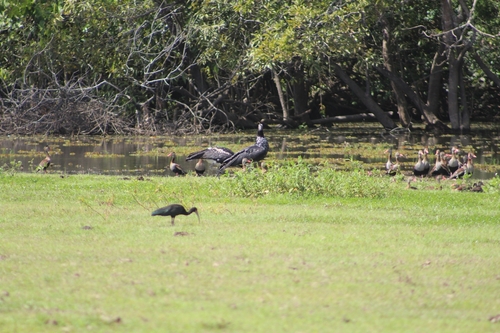
The horned screamer is a massive 84–95 cm (33–37.5 in) long, 3.5 kg (7.7 lb) bird, with a small chicken-like bill. The upperparts, head, and breast are black, with white speckles on the crown, throat and wing coverts. There is a long spiny structure projecting forward from the crown. This structure is unique among birds and is not derived from a feather but is a cornified structure that is loosely attached to the skull and grows continuously while often breaking at its tip. This gives this species its name. It has very long and lanky legs and three large toes in each. Voice: The horned screamer's call, as the name suggests, is a very loud and repetitive echoing sound. It is called "el clon-clon" in Ecuador because of this peculiar feature.
Text from Wikipedia, licensed CC BY-SA 4.0.
When to see the Horned Screamer
One bar for each month, and every month is filled: this bird is recorded here in all twelve. The wide bar is October, the month with the most records.
Where to see the Horned Screamer
The map shades 9 countries with regular records. Everything unshaded has no records. Countries are listed below the map.
About the Horned Screamer
The horned screamer is a species of bird that belongs to a relatively small family, the Anhimidae, which occurs in wetlands of tropical South America. There are three screamer species, the other two being the southern screamer and the northern screamer in the genus Chauna. They are related to ducks, geese and swans, which are in the family Anatidae, but have bills looking more like those of game birds.
Text adapted from Wikipedia, licensed CC BY-SA 4.0.
Easily confused with
 Northern ScreamerChauna chavariaThe northern screamer is 76 to 91 cm (30 to 36 in) long.
 Southern ScreamerChauna torquataThe southern screamer is one of the largest birds of southern South America at 83 to 90 cm (33 to 35 in) long and weighing about 4.4 kg (9.7 lb).
Side by side: Horned Screamer vs Southern Screamer · Horned Screamer vs Northern Screamer
Learn the Horned Screamer in the BeakBrain App
Photo and call practice. Coming soon to iPhone and Android.
Play today's Daily BirdEvery photo and recording on this page is credited to its author under the licence shown. Spotted a problem with this page, or have a better photo? Contribute.