Learn what every symbol on the card means.Full credits and sources at beakbrain.com/symbols
 ForestPlatform nestHuge · 3.7 kg
ID tip
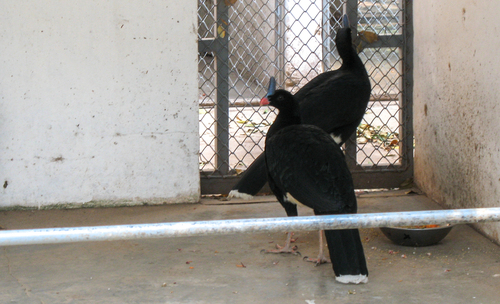
The horned curassow is among the largest cracid species. It measures 85 to 95 cm (33 to 37 in) in length. Body mass in large males is up to 3.7 to 3.9 kg (8.2 to 8.6 lb) and only the great curassow is heavier amongst the cracids, although the black curassow and the closely related helmeted curassow are around the same length. Among standard measurements, the wing chord is 38.1 to 40.2 cm (15.0 to 15.8 in), the tail is 31 to 34.8 cm (12.2 to 13.7 in) and the tarsus is 10 to 10.8 cm (3.9 to 4.3 in). It has a distinctive horn or casque on the forehead which projects for over 6 cm (2.4 in).
Text from Wikipedia, licensed CC BY-SA 4.0.
When to see the Horned Curassow
One bar for each month. Filled bars are the 4 months with records; pale bars are months with none. The wide bar is October, the month with the most records.
Where to see the Horned Curassow
The map shades 1 country with regular records. Everything unshaded has no records. Countries are listed below the map.
About the Horned Curassow
The horned curassow, or southern helmeted curassow, is a species of bird in the family Cracidae found in humid tropical and subtropical forests. It was first described by James Bond and Rodolphe Meyer de Schauensee in 1939 from a specimen collected in Bolivia, and further birds that were described from Peru in 1971 were thought to be a new subspecies. However, the taxonomical position of the birds found in Peru in 1971 is unclear. The horned curassow as originally described is endemic to Bolivia. It is a large, predominantly black bird with a distinctive casque on its forehead.
Text adapted from Wikipedia, licensed CC BY-SA 4.0.
Easily confused with
 Helmeted CurassowPauxi pauxiIt is a large terrestrial black curassow with a small head, large bluish grey casque on forehead, red bill, white-tipped tail feathers, greenish glossed mantle and breast feathers, and white below.
Learn the Horned Curassow in the BeakBrain App
Photo and call practice. Coming soon to iPhone and Android.
Play today's Daily BirdEvery photo and recording on this page is credited to its author under the licence shown. Spotted a problem with this page, or have a better photo? Contribute.