Learn what every symbol on the card means.Full credits and sources at beakbrain.com/symbols
 WetlandCavity nestLarge · 614 g



What the Hooded Merganser sounds like


ID tip
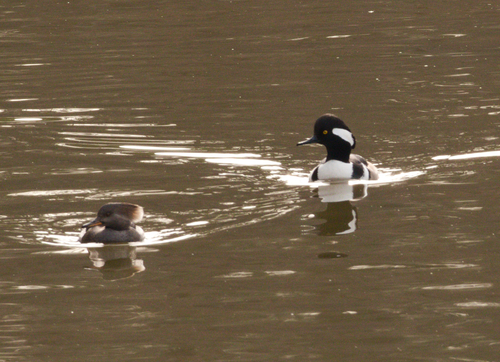
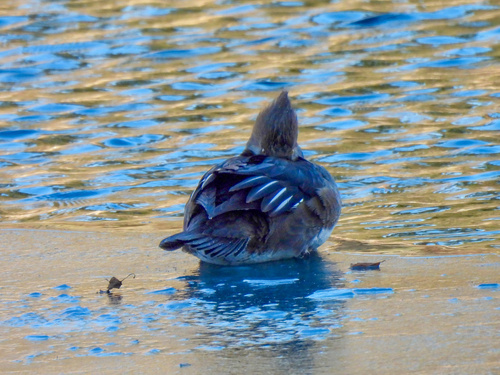
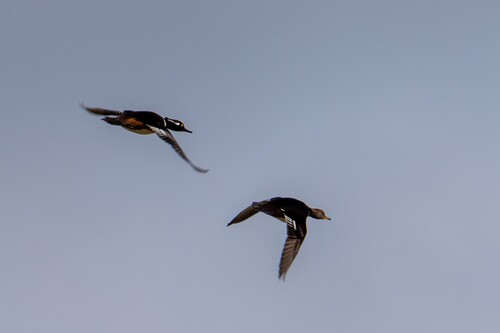
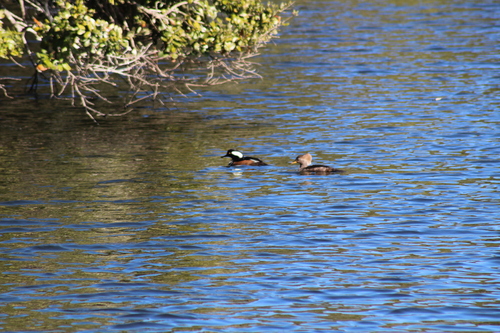
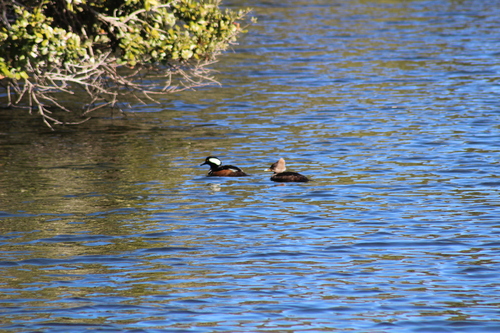
The hooded merganser is a sexually dimorphic species. The adult female has a greyish-brown body, with a narrow white patch over the lower breast and belly. She has a light reddish-brown crest extending from the back of the head. During the nonbreeding season the male looks similar to the female, except that his eyes are yellow and the female's eyes are brown.
Text from Wikipedia, licensed CC BY-SA 4.0.
When to see the Hooded Merganser
One bar for each month. Filled bars are the 8 months with records; pale bars are months with none. The wide bar is January, the month with the most records.
Where to see the Hooded Merganser
The map shades 23 countries with regular records, and 17 more in a lighter tone where the bird turns up only as a stray. Everything unshaded has no records. Countries are listed below the map.
Recorded as a rare visitor in Belgium, Norway, France, Spain, Finland, Costa Rica, Poland, Belize, Austria, Guadeloupe, Martinique, Haiti, St. Barthélemy, Turks & Caicos Islands, Czechia, Lithuania, Slovakia.
About the Hooded Merganser
The hooded merganser is a species of fish-eating duck in the subfamily Anatinae. It is the only extant species in the genus Lophodytes. The genus name derives from the Greek language: lophos meaning 'crest', and dutes meaning 'diver'. The bird is striking in appearance; both sexes have crests that they can raise or lower, and the breeding plumage of the male is handsomely patterned and coloured. The hooded merganser has a sawbill but is not classified as a typical merganser.
Text adapted from Wikipedia, licensed CC BY-SA 4.0.
Easily confused with
 Northern PintailAnas acutaThe northern pintail is a fairly large duck with a wing chord of 23.6–28.2 cm (9.3–11.1 in) and wingspan of 80–95 cm (31–37 in).
 Ring-necked DuckAythya collarisRing-necked ducks are small to medium-sized diving ducks with the following length, weight, and wingspan measurements:
Length: 15.3–18.1 in (39–46 cm)
Weight: 17.3–32.1 oz (490–910 g)
Wingspan: 24.4–24.8 in (62–63 cm)
The adult male is similar in color pattern to the Eurasian tufted duck, its relative.
Ring-necked DuckAythya collarisRing-necked ducks are small to medium-sized diving ducks with the following length, weight, and wingspan measurements:
Length: 15.3–18.1 in (39–46 cm)
Weight: 17.3–32.1 oz (490–910 g)
Wingspan: 24.4–24.8 in (62–63 cm)
The adult male is similar in color pattern to the Eurasian tufted duck, its relative.
 Greylag GooseAnser anserThe greylag is the largest and bulkiest of the grey geese of the genus Anser, but is more lightly built and agile than its domestic relative.
Side by side: Hooded Merganser vs Ring-necked Duck · Hooded Merganser vs Northern Pintail · Greylag Goose vs Hooded Merganser
Learn the Hooded Merganser in the BeakBrain App
Photo and call practice. Coming soon to iPhone and Android.
Play today's Daily BirdEvery photo and recording on this page is credited to its author under the licence shown. Spotted a problem with this page, or have a better photo? Contribute.