Learn what every symbol on the card means.Full credits and sources at beakbrain.com/symbols
 GrasslandDomed nestTiny · 12 g

ID tip
The hooded mannikin is a small munia. It is whitish below, brown above and has a golden to orange rump. It is unlikely to be confused with other birds in its range. The juvenile is similar in appearance to the much larger in size juvenile great-billed mannikin L. grandis. Voice: Both sexes have peep or seep call. However, the loud call note of both sexes is different. The female will have a double-noted sileep or tsilip. The male will have a clear single note seep or tseep. The song consists of entirely of a series high-pitched weee notes. After several wees the male may produce up to 20 pee notes, one after another.
Text from Wikipedia, licensed CC BY-SA 4.0.
When to see the Hooded Mannikin
One bar for each month. Filled bars are the 5 months with records; pale bars are months with none. The wide bar is July, the month with the most records.
Where to see the Hooded Mannikin
The map shades 2 countries with regular records, and 1 more in a lighter tone where the bird turns up only as a stray. Everything unshaded has no records. Countries are listed below the map.
Recorded as a rare visitor in United States.
About the Hooded Mannikin
The hooded mannikin or hooded munia, also known as the New Britain mannikin or Sclater's mannikin, is a species of estrildid finch found in New Britain and New Guinea.
Text adapted from Wikipedia, licensed CC BY-SA 4.0.
Easily confused with
 Yellow-rumped MannikinLonchura flaviprymnaThe yellow-rumped mannikin also known as the yellow-rumped munia, is a species of estrildid finch found in the eastern Kimberley region and north-west Northern Territory, Australia.
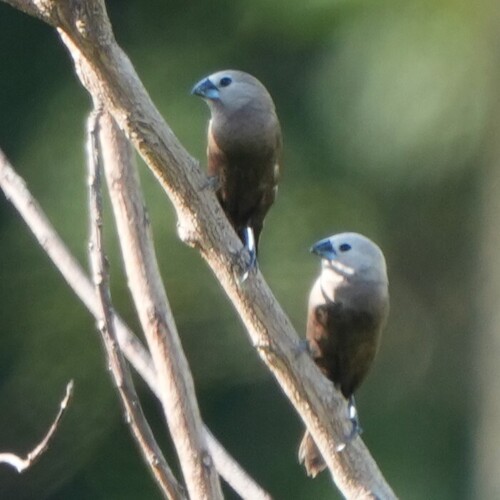 Grey-headed MannikinLonchura canicepsThe grey-headed mannikin or grey-headed munia is a species of estrildid finch, native to the Papuan Peninsula.
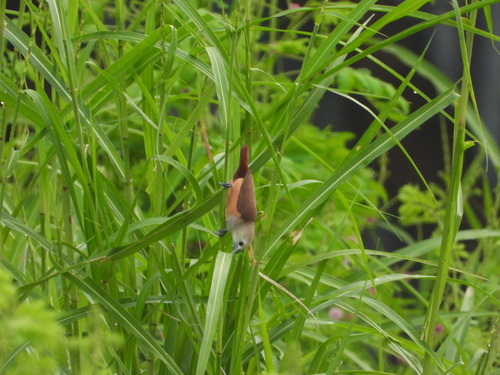 Pale-headed MuniaLonchura pallidaThe pale-headed munia is a small finch measuring approximately 10–11cm in length and weighing around 10–15g, with a striking white or pale buff head contrasting against a dark body.
Learn the Hooded Mannikin in the BeakBrain App
Photo and call practice. Coming soon to iPhone and Android.
Play today's Daily BirdEvery photo and recording on this page is credited to its author under the licence shown. Spotted a problem with this page, or have a better photo? Contribute.