Learn what every symbol on the card means.Full credits and sources at beakbrain.com/symbols
 ForestPlatform nestMedium · 289 g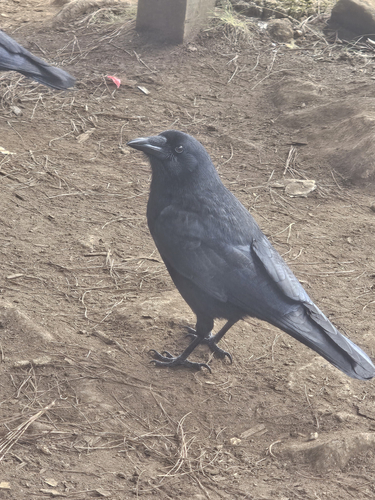
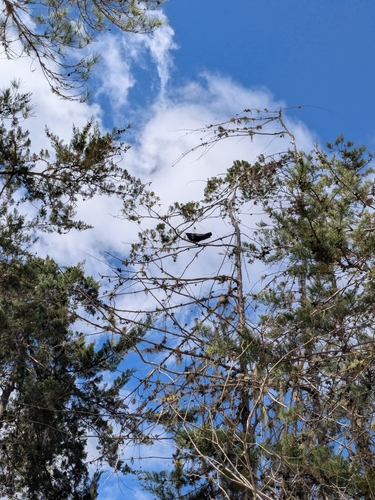
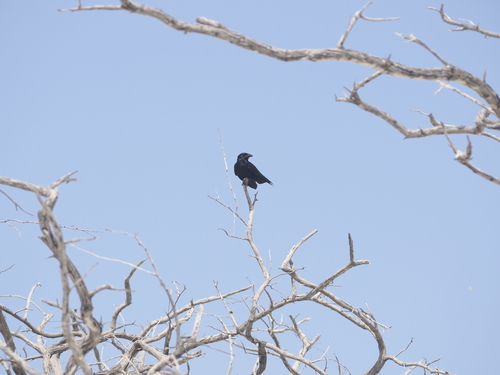
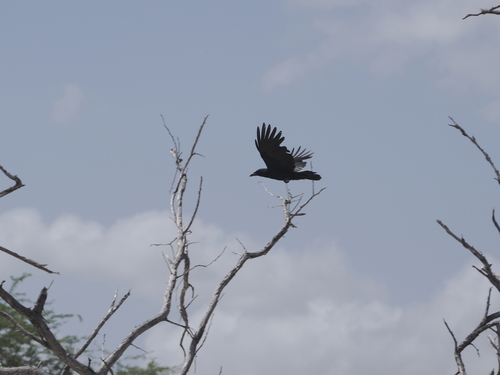
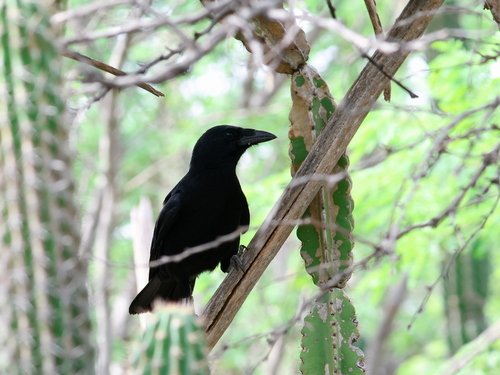
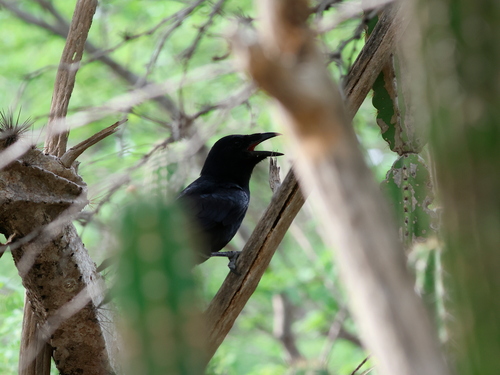

ID tip
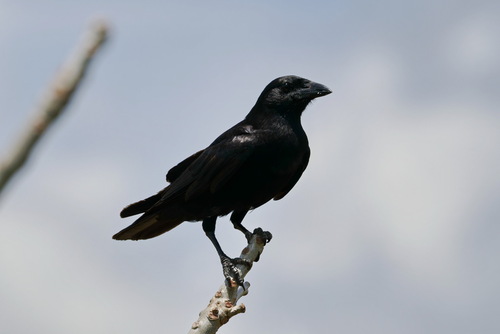
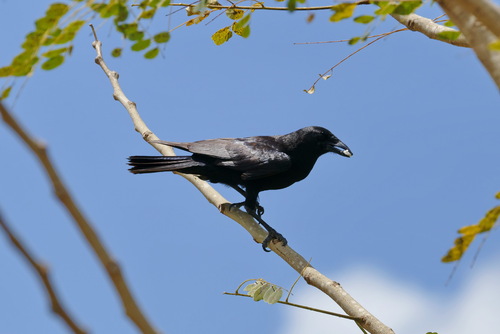
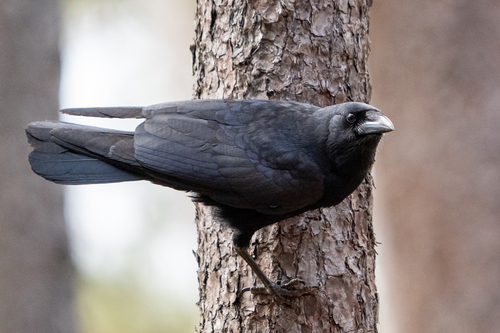
The Hispaniolan palm crow is 34 to 43 cm (13 to 17 in) long; two individuals weighed 229 and 258 g (8.1 and 9.1 oz). The sexes have the same plumage; males are slightly larger than females. Adults are entirely black with much purple-blue iridescence on the mantle and wing coverts when fresh and which becomes dull brownish black when worn. They have a dark brown iris, a black or blackish bill, and black or blackish legs and feet. Juveniles are overall duller than adults. Voice: One of the Hispaniolan palm crow's calls is a "harsh, nasal aaar" with the vowels pronounced as in "fast". Another is "a double-noted cao cao" which provides the species' local Spanish name of "Cao". The species is noted for flicking its tail downwards while calling.
Text from Wikipedia, licensed CC BY-SA 4.0.
When to see the Hispaniolan Palm Crow
One bar for each month. Filled bars are the 11 months with records; pale bars are months with none. The wide bar is March, the month with the most records.
Where to see the Hispaniolan Palm Crow
The map shades 2 countries with regular records, and 1 more in a lighter tone where the bird turns up only as a stray. Everything unshaded has no records. Countries are listed below the map.
Recorded as a rare visitor in Cuba.
About the Hispaniolan Palm Crow
The Hispaniolan palm crow is a relatively small corvid endemic to the Caribbean island of Hispaniola, which is shared by Haiti and the Dominican Republic.
Text adapted from Wikipedia, licensed CC BY-SA 4.0.
Easily confused with
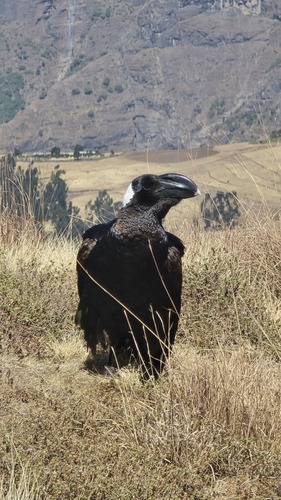 Thick-billed RavenCorvus crassirostrisThe thick-billed raven averages 64 cm (25 in) in length, with a range of 60 to 70 cm (24 to 28 in) and weighs approximately 1.15 kg (2.5 lb) in females and 1.5 kg (3.3 lb) in males on average.
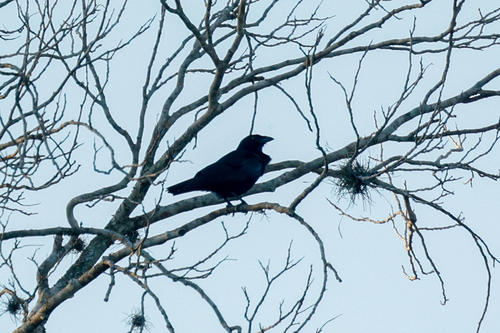 Cuban Palm CrowCorvus minutusThe Cuban palm crow is 34 to 43 cm (13 to 17 in) long; one male weighed 315 g (11 oz) and one female 263 g (9.3 oz).
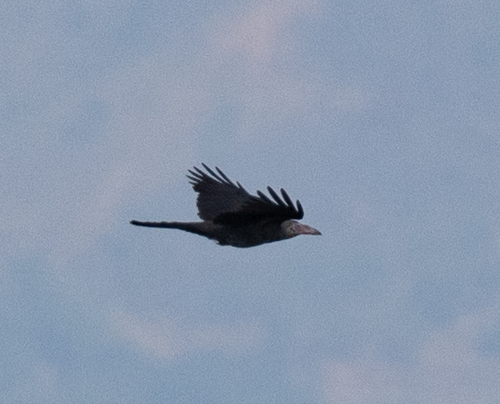 Grey CrowCorvus tristisThe gray crow, formerly known as the bare-faced crow, is about the same size as the Eurasian carrion crow but has somewhat different proportions and quite atypical feather pigmentation during the juvenile phase for a member of this genus.
Learn the Hispaniolan Palm Crow in the BeakBrain App
Photo and call practice. Coming soon to iPhone and Android.
Play today's Daily BirdEvery photo and recording on this page is credited to its author under the licence shown. Spotted a problem with this page, or have a better photo? Contribute.