Learn what every symbol on the card means.Full credits and sources at beakbrain.com/symbols
 ForestCavity nestMedium · 68 g


ID tip
A medium-sized, pied woodpecker reaching a length of about 24 cm (9 in). Glossy black above with broad white patches from shoulder to lower back, limited white barring on flight feathers and clean white tail edgings. Underparts and head white or plain pale buff with black Y-shaped mark on neck and cheeks. The crown is red in males and black in females. Black marks under eyes are unique and distinguish it from other species. Vent and under-tail coverts red or pink. Iris chestnut, beak blackish and legs grey.
Text from Wikipedia, licensed CC BY-SA 4.0.
When to see the Himalayan Woodpecker
One bar for each month. Filled bars are the 9 months with records; pale bars are months with none. The wide bar is May, the month with the most records.
Where to see the Himalayan Woodpecker
The map shades 3 countries with regular records. Everything unshaded has no records. Countries are listed below the map.
About the Himalayan Woodpecker
The Himalayan woodpecker is a species of bird in the family Picidae. It is found in the northern regions of the Indian subcontinent, primarily the Himalayas and some adjoining areas, and ranges across Afghanistan, India, Nepal, Bhutan and Pakistan. Its natural habitats are boreal forests and temperate forests. The International Union for Conservation of Nature has assessed its conservation status as being of "least concern".
Text adapted from Wikipedia, licensed CC BY-SA 4.0.
Easily confused with
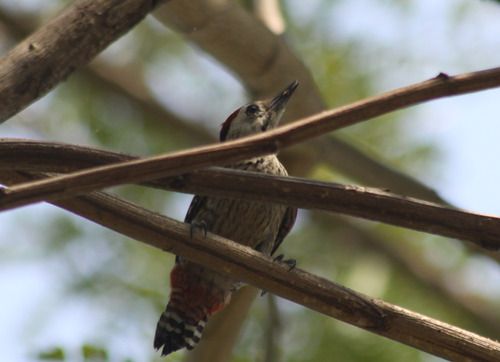 Freckle-breasted WoodpeckerDendrocopos analisA medium-sized, pied woodpecker.
 Rufous-bellied WoodpeckerDendrocopos hyperythrusThe rufous-bellied woodpecker ranges in length from about 19 to 23 cm (7.5 to 9.1 in).
 Darjeeling WoodpeckerDendrocopos darjellensisA medium-sized pied woodpecker with yellow neck sides.
Side by side: Himalayan Woodpecker vs White-backed Woodpecker · Fulvous-breasted Woodpecker vs Himalayan Woodpecker · Freckle-breasted Woodpecker vs Himalayan Woodpecker · Himalayan Woodpecker vs Rufous-bellied Woodpecker · Darjeeling Woodpecker vs Himalayan Woodpecker
Learn the Himalayan Woodpecker in the BeakBrain App
Photo and call practice. Coming soon to iPhone and Android.
Play today's Daily BirdEvery photo and recording on this page is credited to its author under the licence shown. Spotted a problem with this page, or have a better photo? Contribute.