Learn what every symbol on the card means.Full credits and sources at beakbrain.com/symbols
 ForestScrapeHuge · 2.1 kg


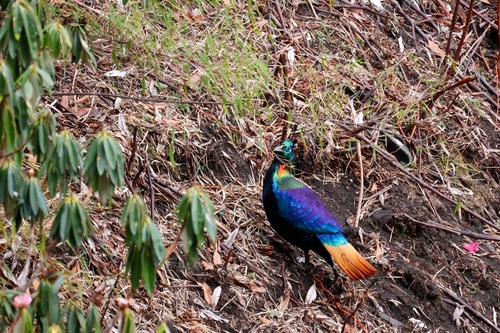
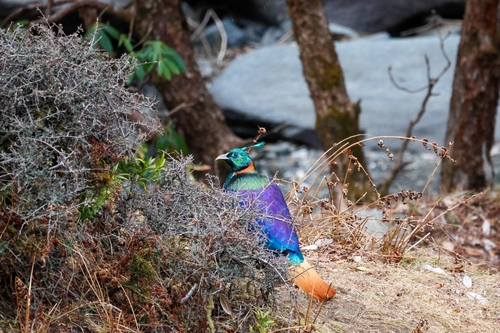
ID tip
It is a relatively large-sized landfowl, 24–30 in (61–76 cm) long and weighing 3–5 pounds (1.4–2.3 kg). The adult male has multicoloured plumage throughout, while the female, as in other landfowl, is more subdued in colour. Notable features in the male include a long, metallic green crest, coppery feathers on the back and neck, and a prominent white rump that is most visible when the bird is in flight. The male's tail feathers are uniformly rufous, darkening towards the tips, whereas the female's lower tail coverts are white, barred with black and red.
Text from Wikipedia, licensed CC BY-SA 4.0.
When to see the Himalayan Monal
One bar for each month. Filled bars are the 8 months with records; pale bars are months with none. The wide bar is April, the month with the most records.
Where to see the Himalayan Monal
The map shades 7 countries with regular records. Everything unshaded has no records. Countries are listed below the map.
About the Himalayan Monal
The Himalayan monal, also called Impeyan monal, is a landfowl native to Himalayan forests and shrublands at elevations of 2,100–4,500 m (6,900–14,800 ft). It is part of the family Phasianidae and is listed as Least Concern on the IUCN Red List. It is the national bird of Nepal, where it is known as the danphe or danfe, and state bird of Uttarakhand, India, where it is known as a monal. The scientific name commemorates Lady Mary Impey, the wife of the British chief justice of Bengal, Sir Elijah Impey.
Text adapted from Wikipedia, licensed CC BY-SA 4.0.
Easily confused with
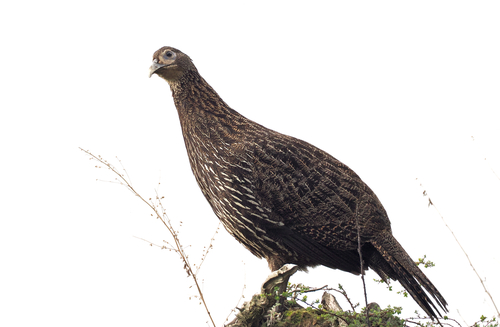 Chinese MonalLophophorus lhuysiiThis is the largest of the three monals and, by weight, is one of the larger species of Phasianidae, after the turkeys, the peafowls, and the capercaillies.
 Sclater's MonalLophophorus sclateriSclater's monal is a large, approximately 68 centimetres (27 in) long, monal pheasant.
Learn the Himalayan Monal in the BeakBrain App
Photo and call practice. Coming soon to iPhone and Android.
Play today's Daily BirdEvery photo and recording on this page is credited to its author under the licence shown. Spotted a problem with this page, or have a better photo? Contribute.