Learn what every symbol on the card means.Full credits and sources at beakbrain.com/symbols
 ForestCavity nestSmall · 43 g


ID tip
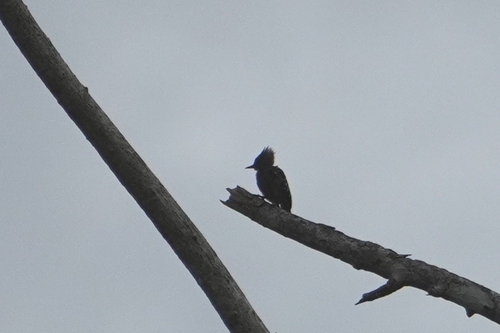
A small, uniquely shaped, black and buff woodpecker with a large crest making the head look large for the short body and tail. Both males and females are predominantly black with heart-shaped black spots on white shoulders with broad white scapular patches and barring of flight feathers. The female has the forehead and crown buffy white while on males it is black with small white dots. The throat is whitish and the underparts are dark olive grey. A tuft of feathers on the back are specialized and are lipid rich which causes the feathers to stick together in preserved specimens.
Text from Wikipedia, licensed CC BY-SA 4.0.
When to see the Heart-spotted Woodpecker
One bar for each month. Filled bars are the 9 months with records; pale bars are months with none. The wide bar is February, the month with the most records.
Where to see the Heart-spotted Woodpecker
The map shades 6 countries with regular records. Everything unshaded has no records. Countries are listed below the map.
About the Heart-spotted Woodpecker
The heart-spotted woodpecker is a species of bird in the woodpecker family. It has a contrasting black and white plumage, a distinctively stubby body and a large wedge-shaped head making it easy to identify while its frequent calling make it easy to detect as it forage for invertebrates under the bark of the slender outer branches of trees. They move about in pairs or small groups and are often found in mixed-species foraging flocks. They have a wide distribution across Asia with populations in the forests of southwestern and central India which are slightly separated from their ranges in the Himalayas and Southeast Asia.
Text adapted from Wikipedia, licensed CC BY-SA 4.0.
Easily confused with
Learn the Heart-spotted Woodpecker in the BeakBrain App
Photo and call practice. Coming soon to iPhone and Android.
Play today's Daily BirdEvery photo and recording on this page is credited to its author under the licence shown. Spotted a problem with this page, or have a better photo? Contribute.