Learn what every symbol on the card means.Full credits and sources at beakbrain.com/symbols
 WoodlandGround nest429 g




What the Hazel Grouse sounds like


ID tip
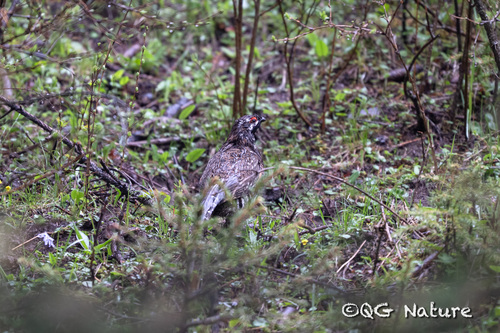
This is a relatively small grouse at 35–39 cm (14–15 in) length. The plumage of this plump bird is finely patterned, but it essentially has grey upperparts, brown wings and chestnut flecked white underparts. The male has a short erectile crest and a white-bordered black throat. The female has a shorter crest and lacks the black color on the throat. In flight, this species shows a black-tipped grey tail. The male has a high-pitched ti-ti-ti-ti-ti call, and the female a liquid tettettettettet.
Text from Wikipedia, licensed CC BY-SA 4.0.
When to see the Hazel Grouse
One bar for each month, and every month is filled: this bird is recorded here in all twelve. The wide bar is May, the month with the most records.
Where to see the Hazel Grouse
The map shades 31 countries with regular records, and 4 more in a lighter tone where the bird turns up only as a stray. Everything unshaded has no records. Countries are listed below the map.
Recorded as a rare visitor in Belgium, Luxembourg, Montenegro, Liechtenstein.
About the Hazel Grouse
The hazel grouse, sometimes called the hazel hen, is one of the smaller members of the grouse tribe of birds. It is a sedentary species, breeding across the Palearctic as far east as Hokkaido, and as far west as eastern and central Europe, in dense, damp, mixed coniferous woodland, preferably with some spruce. The bird is sometimes referred to as "rabchick" by early 20th century English speaking travellers to Russia.
Text adapted from Wikipedia, licensed CC BY-SA 4.0.
Easily confused with
Learn the Hazel Grouse in the BeakBrain App
Photo and call practice. Coming soon to iPhone and Android.
Play today's Daily BirdEvery photo and recording on this page is credited to its author under the licence shown. Spotted a problem with this page, or have a better photo? Contribute.