Learn what every symbol on the card means.Full credits and sources at beakbrain.com/symbols
 ForestPlatform nestHuge · 4.8 kg




ID tip
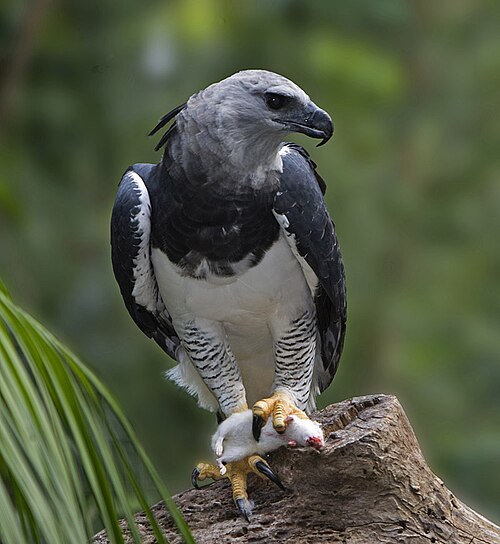
The upperside of the harpy eagle is covered with slate-black feathers, and the underside is mostly white, except for the feathered tarsi, which are striped black. A broad black band across the upper breast separates the gray head from the white belly. The head is pale grey, and is crowned with a double crest. The upperside of the tail is black with three gray bands, while the underside of it is black with three white bands. The irises are gray or brown or red, the cere and bill are black or blackish and the tarsi and toes are yellow. The plumage of males and females is identical. Voice: This species is largely silent away from the nest. There, the adults give a penetrating, weak, melancholy scream, with the incubating males' call described as "whispy screaming or wailing". The females' calls while incubating are similar, but are lower-pitched. While approaching the nest with food, the male calls out "rapid chirps, goose-like calls, and occasional sharp screams".
Text from Wikipedia, licensed CC BY-SA 4.0.
When to see the Harpy Eagle
One bar for each month, and every month is filled: this bird is recorded here in all twelve. The wide bar is October, the month with the most records.
Where to see the Harpy Eagle
The map shades 14 countries with regular records, and 3 more in a lighter tone where the bird turns up only as a stray. Everything unshaded has no records. Countries are listed below the map.
Recorded as a rare visitor in Costa Rica, Mexico, Guatemala.
About the Harpy Eagle
The harpy eagle is a large neotropical species of eagle. It is also called the American harpy eagle to distinguish it from the Papuan eagle, which is sometimes known as the New Guinea harpy eagle or Papuan harpy eagle. It is the largest bird of prey throughout its range, and among the largest extant species of eagles in the world. It usually inhabits tropical lowland rainforests in the upper (emergent) canopy layer. Destruction of its natural habitat has caused it to vanish from many parts of its former range, and it is nearly extirpated from much of Central America.
Text adapted from Wikipedia, licensed CC BY-SA 4.0.
Easily confused with
 White-throated HawkButeo albigulaThe white-throated hawk is 38 to 48 cm (15 to 19 in) long with an 84 to 102 cm (33 to 40 in) wingspan.
 Tiny HawkMicrospizias superciliosusThe tiny hawk is aptly named; males measure 20 cm (7.9 in), about the size of a starling, though females are slightly larger at 26.5 cm (10.5 in).
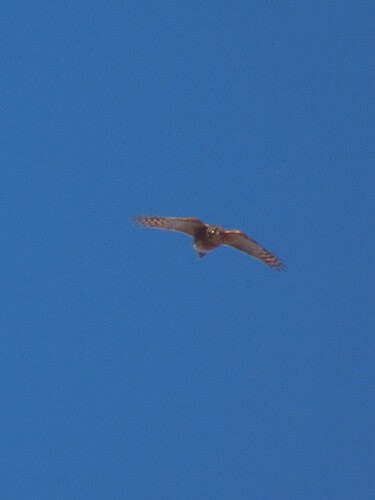 Rufous-breasted SparrowhawkAccipiter rufiventrisA small raptor, with a height of about 30 cm and wingspan of 72 cm, the rufous-breasted sparrowhawk is named for its distinctive rufous-coloured underparts, which can be seen both perching and in flight.
Side by side: Harpy Eagle vs Tiny Hawk · Harpy Eagle vs Rufous-breasted Sparrowhawk · Harpy Eagle vs White-throated Hawk
Learn the Harpy Eagle in the BeakBrain App
Photo and call practice. Coming soon to iPhone and Android.
Play today's Daily BirdEvery photo and recording on this page is credited to its author under the licence shown. Spotted a problem with this page, or have a better photo? Contribute.