Learn what every symbol on the card means.Full credits and sources at beakbrain.com/symbols
 UrbanPlatform nestMedium · 82 g


What the Groove-billed Ani sounds like


ID tip
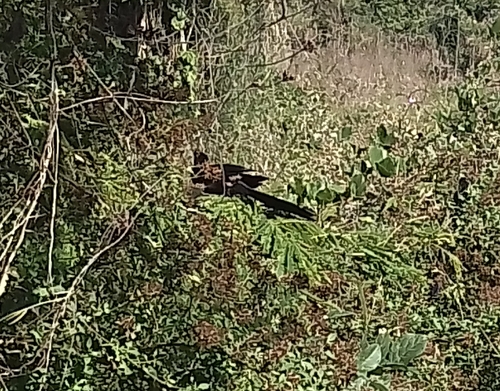
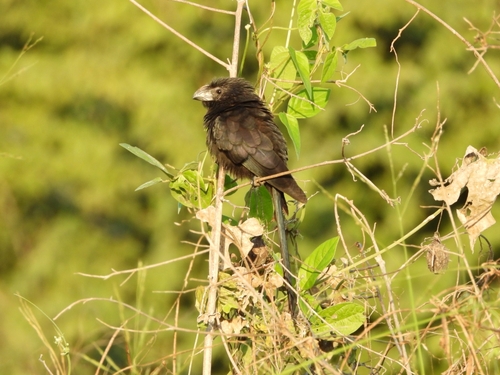
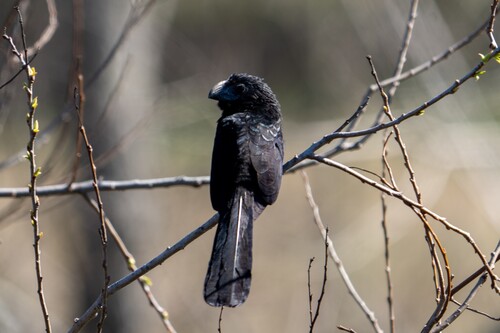
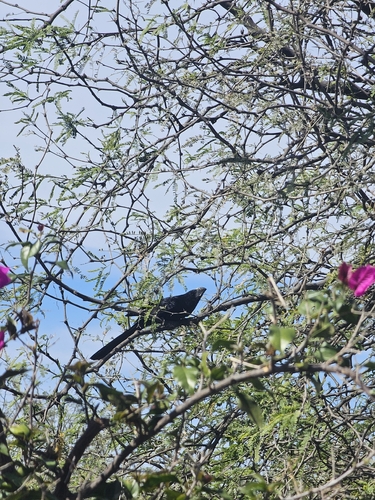
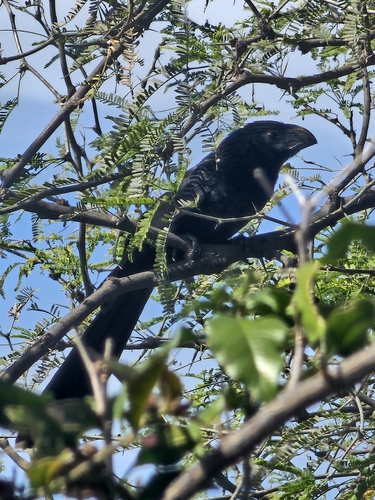
The groove-billed ani is about 34 cm (13 in) long, and weighs 70–90 g (2.5–3.2 oz). Wingspan ranges 41–46 cm (16–18 in). It is completely black, with a very long tail almost as long as its body. It has a huge bill with lengthwise grooves running the length of the upper mandible. It is very similar to the smooth-billed ani, some specimens of which have bills as small as the groove-billed and with grooves on the basal half. The two species are best distinguished by voice and range. In flight, the ani alternates between quick, choppy flaps and short glides.
Text from Wikipedia, licensed CC BY-SA 4.0.
When to see the Groove-billed Ani
One bar for each month, and every month is filled: this bird is recorded here in all twelve. The wide bar is January, the month with the most records.
Where to see the Groove-billed Ani
The map shades 17 countries with regular records, and 1 more in a lighter tone where the bird turns up only as a stray. Everything unshaded has no records. Countries are listed below the map.
Recorded as a rare visitor in Canada.
About the Groove-billed Ani
The groove-billed ani is a tropical bird in the cuckoo family with a long tail and a large, curved beak. It is a resident species throughout most of its range, from southern Texas, central Mexico and The Bahamas, through Central America, to northern Colombia and Venezuela, and coastal Ecuador and Peru. It only retreats from the northern limits of its range in Texas and northern Mexico during winter.
Text adapted from Wikipedia, licensed CC BY-SA 4.0.
Easily confused with
 Smooth-billed AniCrotophaga aniThe smooth-billed ani is a mid-sized species, larger on average than the groove-billed ani but smaller than the greater ani.
 Greater AniCrotophaga majorThe greater ani is about 46 cm (18 in) in length.
Side by side: Groove-billed Ani vs Smooth-billed Ani · Greater Ani vs Groove-billed Ani
Learn the Groove-billed Ani in the BeakBrain App
Photo and call practice. Coming soon to iPhone and Android.
Play today's Daily BirdEvery photo and recording on this page is credited to its author under the licence shown. Spotted a problem with this page, or have a better photo? Contribute.