Learn what every symbol on the card means.Full credits and sources at beakbrain.com/symbols
 MarineSmall · 75 g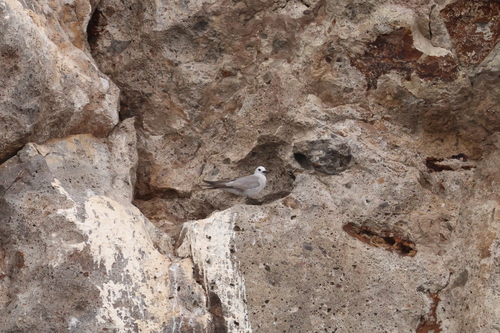


ID tip
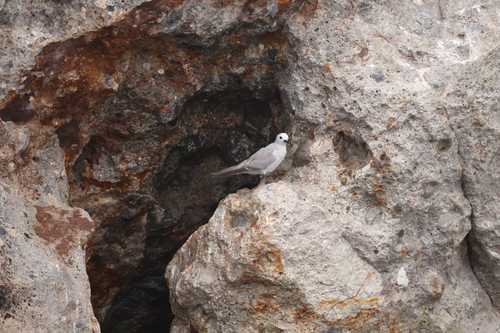
The grey noddy is 28–31 cm (11–12 in) long with a wingspan of 46–60 cm (18–24 in) and a weight of about 75 grams (2.6 oz). The tail is fairly long and notched. The plumage is pale grey, almost white on the head and underparts but darker on the back, tail and wings. The wings have dark tips and a white hind edge and are mainly white underneath. The eye is black and appears large due to the black patch in front of it. There is a white patch behind the eye. The thin, pointed bill is black and the legs and feet are also black apart from pale yellow webs.
Text from Wikipedia, licensed CC BY-SA 4.0.
When to see the Grey Noddy
One bar for each month. Filled bars are the 7 months with records; pale bars are months with none. The wide bar is March, the month with the most records.
Where to see the Grey Noddy
The map shades 5 countries with regular records, and 1 more in a lighter tone where the bird turns up only as a stray. Everything unshaded has no records. Countries are listed below the map.
Recorded as a rare visitor in New Caledonia.
About the Grey Noddy
The grey noddy or grey ternlet is a seabird belonging to the family Laridae. It was once regarded as a pale morph of the blue noddy but is now usually considered to be a separate species.
Text adapted from Wikipedia, licensed CC BY-SA 4.0.
Easily confused with
 Blue NoddyAnous ceruleusThe blue noddy is 25–28 cm (9.8–11.0 in) in length and has a wingspan of 46–60 cm (18–24 in).
 Lesser NoddyAnous tenuirostrisThe lesser noddy is 30–34 cm (12–13 in) in length with a wingspan of 58–63 cm (23–25 in) and a weight of 97–120 g (3.4–4.2 oz).
 Black NoddyAnous minutusThe black noddy has a length of 35–37 cm (14–15 in), a wingspan of 66–72 cm (26–28 in) and a weight of 98–144 g (3.5–5.1 oz).
Learn the Grey Noddy in the BeakBrain App
Photo and call practice. Coming soon to iPhone and Android.
Play today's Daily BirdEvery photo and recording on this page is credited to its author under the licence shown. Spotted a problem with this page, or have a better photo? Contribute.